Key takeaways
- No single person invented the saree because the garment developed gradually from ancient draped-cloth traditions across South Asia.
- Archaeological figurines and early Indian texts provide clues about draped clothing, but they do not prove that a modern saree existed in the Indus Valley period.
- The modern saree commonly uses an unstitched rectangular cloth, while the blouse and petticoat became standard in many regions much later.
- Regional sarees such as Kanjeevaram, Banarasi silk, Chanderi and Kalamkari reflect distinct weaving, dyeing and draping traditions.
- A saree's fabric, border, pallu and drape can help identify its cultural context more reliably than a broad claim about one inventor.
A surprising fact sits at the centre of the question "who invented saree": historians can't name one inventor, one kingdom or one exact year. The saree developed gradually from the South Asian practice of wrapping and draping long lengths of cloth, with regional weavers and wearers shaping its form over centuries. The modern saree is therefore better understood as a living textile tradition than as a single invention.
This guide uses a practical, numbered method to investigate the saree's origins. You will learn how to separate archaeological evidence from popular legends, identify the parts that changed over time, read regional textile clues and choose a saree with a more informed understanding of its history.
Step 1: Start with the direct answer to who invented saree
No single person invented the saree; the garment evolved through many South Asian draping, weaving and dress traditions over a very long period.
The word "saree" describes a family of garments rather than one fixed design that appeared fully formed. A long, rectangular length of cloth could be wrapped around the lower body, passed over the shoulder, pleated, tucked or arranged in several regional ways. Different communities adapted the cloth to climate, work, ritual, modesty, social customs and available textile technology.
That explanation also clarifies why claims assigning the saree to one goddess, king or ancient ruler should be treated as cultural stories rather than documented invention records. Religious narratives can explain why a garment is meaningful, but they don't provide the same kind of evidence as dated textiles, inscriptions or securely identified sculptures.
The most accurate short answer is that the saree has no single inventor because its design emerged through cumulative cultural change.
Step 2: Check what ancient evidence can-and can't-prove
Ancient evidence shows that draped garments existed in South Asia, but it doesn't prove that people wore the current saree in its present form.
Researchers examine terracotta figures, sculptures, paintings, coins, written references and surviving textile fragments to understand early clothing. Some Indus Valley figurines are interpreted as wearing wrapped or draped lower garments, although small figurines rarely preserve enough detail to identify an exact garment. The evidence is useful for showing that draping was an old practice, not for naming a saree inventor.
Early Indian literature also refers to cloth, garments and methods of wrapping, but literary descriptions can be poetic, incomplete or difficult to map onto contemporary clothing. Buddhist and Jain art, as well as later temple sculpture, provides more visual evidence of wrapped lower garments and cloths passing around the body. None of these sources demonstrates that a single standard saree existed across the subcontinent.
Another limitation is preservation. Organic fibres such as cotton, silk and linen decay easily in hot, humid soil. A missing ancient textile doesn't mean that woven cloth was absent; it means that the archaeological record is incomplete. For that reason, responsible saree history uses phrases such as "evidence suggests" instead of treating a legendary date as settled fact.
Step 3: Understand the garment before tracing its evolution
A saree is traditionally a long, unstitched or minimally stitched rectangular cloth arranged around the body, usually with a distinct pallu or end section.
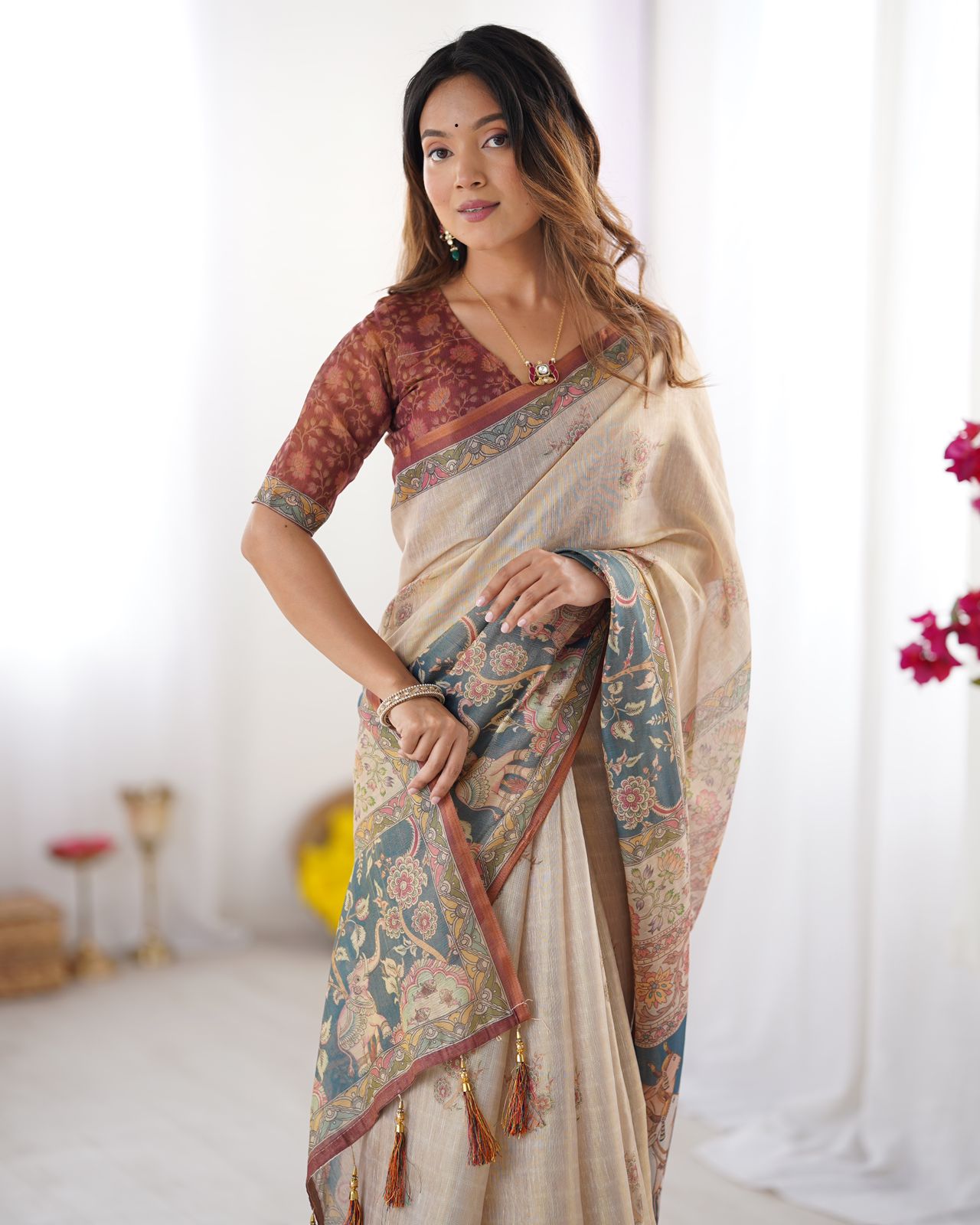
The rectangular construction matters because it allows a single textile to serve other purposes. A wearer can alter the length tucked at the waist, the number of pleats, the shoulder arrangement and the way the pallu is secured. Regional drapes can therefore look radically different while still go to the broad saree family.
What are the main parts of a saree?
The main parts are the body, border, pallu and fall area, although terminology and construction vary by region.
- Body: The largest field of the saree carries the primary colour, weave, print or motif.
- Border: The lengthwise edge may use contrast yarns, zari, extra-weft motifs or printed decoration.
- Pallu: The decorated end is often displayed over the shoulder and can carry the strongest storytelling or ceremonial design.
- Fall area: A reinforcing strip may be attached to the lower edge to reduce abrasion during repeated wear.
- Blouse pairing: A blouse is now common, but the cut, sleeve, neckline and fabric pairing reflect changing regional and social practices rather than an original universal rule.
A weave like Pastel Floral Tissue Handloom Cotton Saree with Zari Weaves demonstrates why construction and surface design should be considered together. Cotton, tissue-like texture and zari produce a different visual and tactile language from a dense silk jacquard, even when both garments use the same basic rectangular format.
Step 4: Separate ancient draping from the contemporary saree
The up-to-date saree emerged through layers of regional custom, textile production, colonial-era change and twentieth-century fashion rather than appearing in one historical moment.
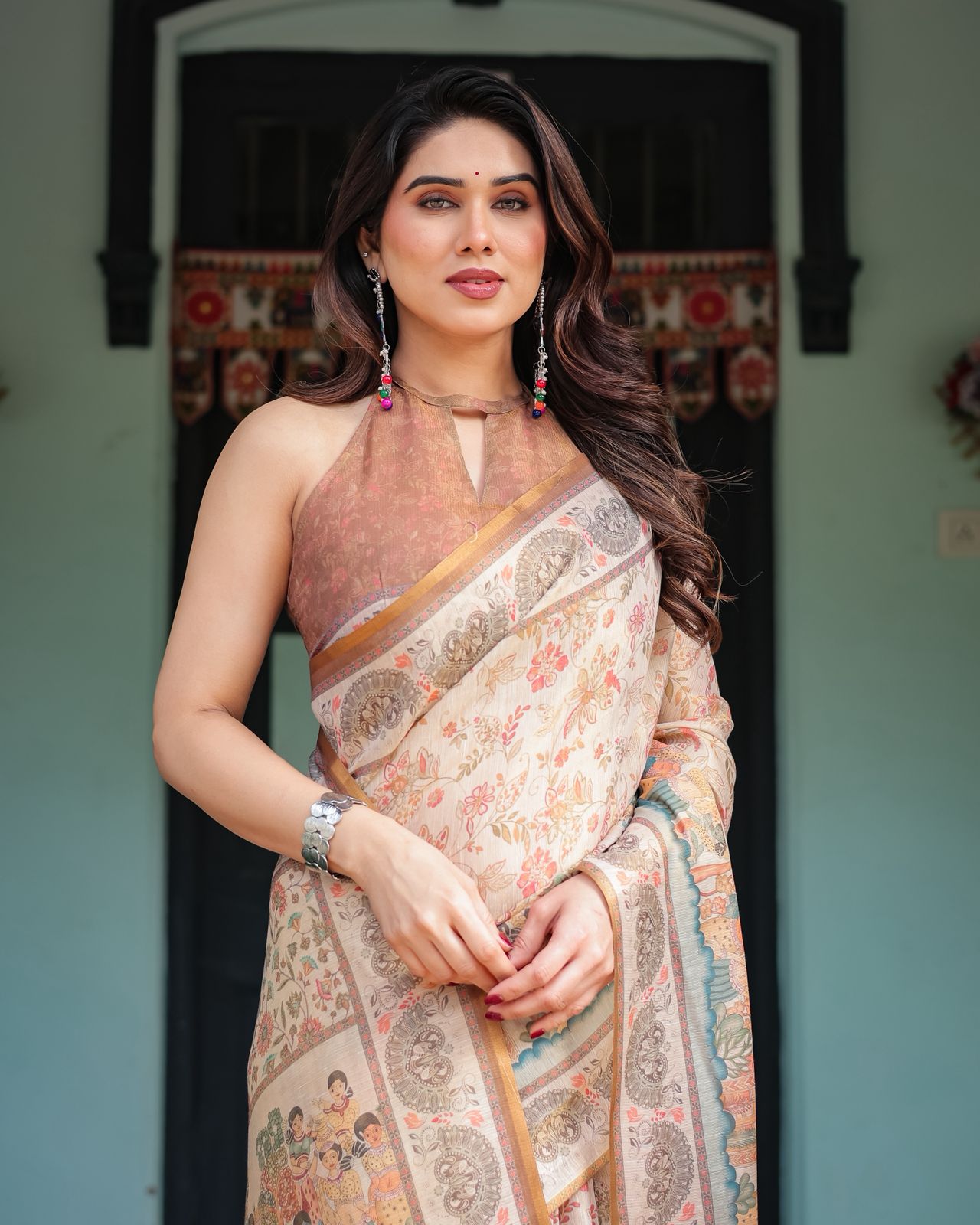
Older draped clothing did not necessarily include the fitted blouse and petticoat combination that many shoppers now regard as standard. In several parts of India, women historically used different combinations of wrapped cloths, breast cloths, waist garments and upper-body coverings. Blouse shapes and petticoats became more widespread through changing ideas of respectability, urban dress, tailoring access, education, media and social reform.
The popular Nivi drape, with front pleats and the pallu over the left shoulder, is now widely recognised across India. Its current dominance should not be mistaken for proof that it's the original saree drape. India has long supported other arrangements, including the Bengali, Gujarati, Maharashtrian, Kodagu, Kerala and Madisar styles, each with its own method of tucking, pleating and securing the cloth.
Textile names also preserve regional histories. Kanjeevaram is associated with the silk-weaving tradition of Kanchipuram. Banarasi silk is linked to Varanasi's brocade heritage and often uses elaborate zari work. Chanderi is valued for its lightweight handloom character and transparent, airy appearance. Kalamkari refers to a painted or printed textile tradition with strong links to Andhra Pradesh and Telangana. These names identify specific cultural and technical histories; they're not interchangeable labels for every saree.
Step 5: Read a saree's history through its material clues
You can learn more about a saree's regional and technical story by examining fibre, weave, surface treatment, border, pallu and finishing details.

- Identify the fibre: Check whether the saree is cotton, silk, wool, linen, a blend or a synthetic fibre. Fibre affects breathability, weight, shine and care.
- Look at the structure: Handloom irregularities, jacquard patterning, printed motifs and woven zari reveal different production methods.
- Study the pallu: A narrative pallu, geometric end panel or dense brocade can indicate the design tradition and intended formality.
- Inspect the border: Contrast borders often define a regional visual vocabulary, while delicate printed borders may suit lighter everyday fabrics.
- Ask about care: Dry-clean-only silk and zari require different handling from washable cotton or linen-cotton blends.
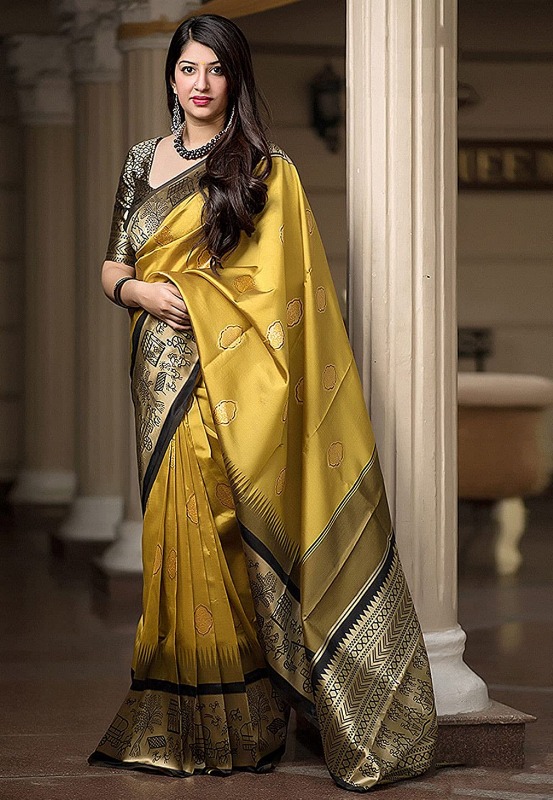
Heritage Mustard Jacquard Silk Saree is an useful example of how a jacquard surface creates pattern through the textile structure rather than relying only on a surface print. Designer Rani Pink Patola Print Pashmina Silk Festive Saree, by contrast, points the eye toward a print-led interpretation of a highly recognisable festive textile vocabulary.
Print and storytelling are also important historical clues. Tussar Silk Kalamkari Printed Saree with Blouse brings together a silk base and a Kalamkari-inspired visual tradition, while Ivory Rust Handloom Floral Saree with Storytelling Pallu shows how the pallu can function as the main narrative area of a contemporary design. Such examples demonstrate continuity and adaptation rather than a frozen ancient costume.
Step 6: Match the saree's history to the way you plan to wear it
The most practical saree choice depends on climate, movement, event formality, drape stability and care time rather than historical prestige alone.
Which saree works for a warm daytime event?
A breathable cotton or linen-cotton saree is usually the most practical choice for a warm daytime event.
Lightweight handloom cotton can be comfortable for several hours, particularly when the pleats are secured neatly and the blouse allows arm movement. Coral Floral Linen Cotton Saree with Designer Border offers an useful reference point for combining a breathable-looking base with a defined border that keeps the outfit visually polished.
Which saree suits a formal evening?
Silk, jacquard, zari or organza-cotton silk sarees generally create a more formal evening effect, although the final result depends on weight and styling.
Elegant Charcoal Garden Organza Cotton Silk Saree illustrates how a darker neutral and a sheer-textured construction can feel dressy without relying on a very bright colour. Zari, dense borders and structured pleats can increase visual formality, but heavier fabric may require stronger waist support and more careful pinning.
How can a heritage-inspired saree remain wearable?
A heritage-inspired saree remains wearable when the fabric weight, blouse fit and drape method suit the person wearing it.
Ivory Cream Floral Handloom Saree with Heritage Pallu can be styled with a simple blouse to let the pallu remain the focal point. A handloom saree may have slight variations in weave or motif placement, which are normal signs of textile production rather than defects. A wearer should inspect the selvedge, check for loose zari and confirm care instructions before purchasing.
Step 7: Use a careful method when buying a saree online
A reliable online purchase requires checking measurements, fabric composition, transparency, blouse details, care instructions and return conditions before comparing price.
- Read the fibre description: "Silk," "silk blend," "cotton," "linen cotton" and "organza cotton silk" indicate different expectations for weight and maintenance.
- Check the saree length and width: A standard length may not suit every height, preferred drape or number of pleats.
- Confirm blouse information: Check whether a blouse piece is included, whether the piece is attached or separate and whether tailoring will be needed.
- Zoom into the pallu and border: Product photographs often show the most important design details at the ends of the saree.
- Compare price by construction: Jacquard weaving, handloom production, zari and silk generally affect price differently from a printed design.
- Plan care before ordering: Ask whether the garment needs dry cleaning, gentle hand washing, shade drying or storage in breathable fabric.
Budget browsing can be organised through Sarees from Rs 1000 to Rs 1500, while discount-led searches may include Sarees Under 20% Off, Sarees Under 10% Off and Sarees Flat 60% Off. A discount label doesn't establish fibre quality or historical authenticity, so the product specifications still deserve priority.
What the saree's history means today
The saree remains relevant because its basic format permits constant reinterpretation without losing its connection to regional textile knowledge.
A contemporary saree may combine handloom cotton with floral motifs, silk with printed Kalamkari imagery, organza with a garden pattern or a heritage-style pallu with a simplified blouse. Those combinations don't make the garment less traditional. They show how tradition operates: techniques, symbols and forms are carried forward while colours, fibres, borders and styling respond to new lives.
The strongest answer to who invented saree is therefore not a person's name but a history of collective making. Farmers produced fibres, spinners prepared yarn, dyers developed colour, weavers built cloth, artists created motifs, tailors shaped blouses and wearers developed drapes suited to their communities. Each stage contributed to what people now recognise as the saree.
When you examine a saree through its fibre, weave, pallu and drape, you can appreciate both its ancient foundation and its modern design choices. That approach is more accurate-and more useful-than searching for one inventor who never existed.
Frequently Asked Questions
Who invented saree according to history?
No single person invented the saree. The saree evolved gradually from ancient South Asian practices of wrapping and draping rectangular cloth, with different regions contributing their own fabrics, borders and drapes.
Was the saree worn in the Indus Valley Civilisation?
Archaeological figurines suggest that wrapped or draped garments existed during the Indus Valley Civilisation. The available evidence cannot confirm that people wore the modern saree, or identify one standard saree style from that period.
Did sarees originally have blouses and petticoats?
Blouses and petticoats were not a universal original feature of sarees. Many communities used varied combinations of wrapped cloths and upper-body garments, while the blouse-and-petticoat pairing became more widespread through later social, tailoring and fashion changes.
What is the oldest saree style in India?
No single saree style can be proven to be the oldest because early evidence is incomplete and regional draping traditions developed separately. Styles such as Bengali, Gujarati, Maharashtrian, Kerala and Madisar drapes preserve different historical practices.
How are Banarasi silk, Kanjeevaram and Chanderi sarees different?
Banarasi silk is associated with Varanasi brocade and zari traditions, Kanjeevaram is linked to the silk-weaving heritage of Kanchipuram, and Chanderi is known for lightweight handloom textiles with an airy appearance. Each name refers to a distinct textile history rather than a generic saree category.
How should I choose a saree for a daytime function?
Choose a breathable cotton or linen-cotton saree with a manageable weight for a warm daytime function. Check the fibre, saree dimensions, blouse details and care instructions before selecting colour or embellishment.