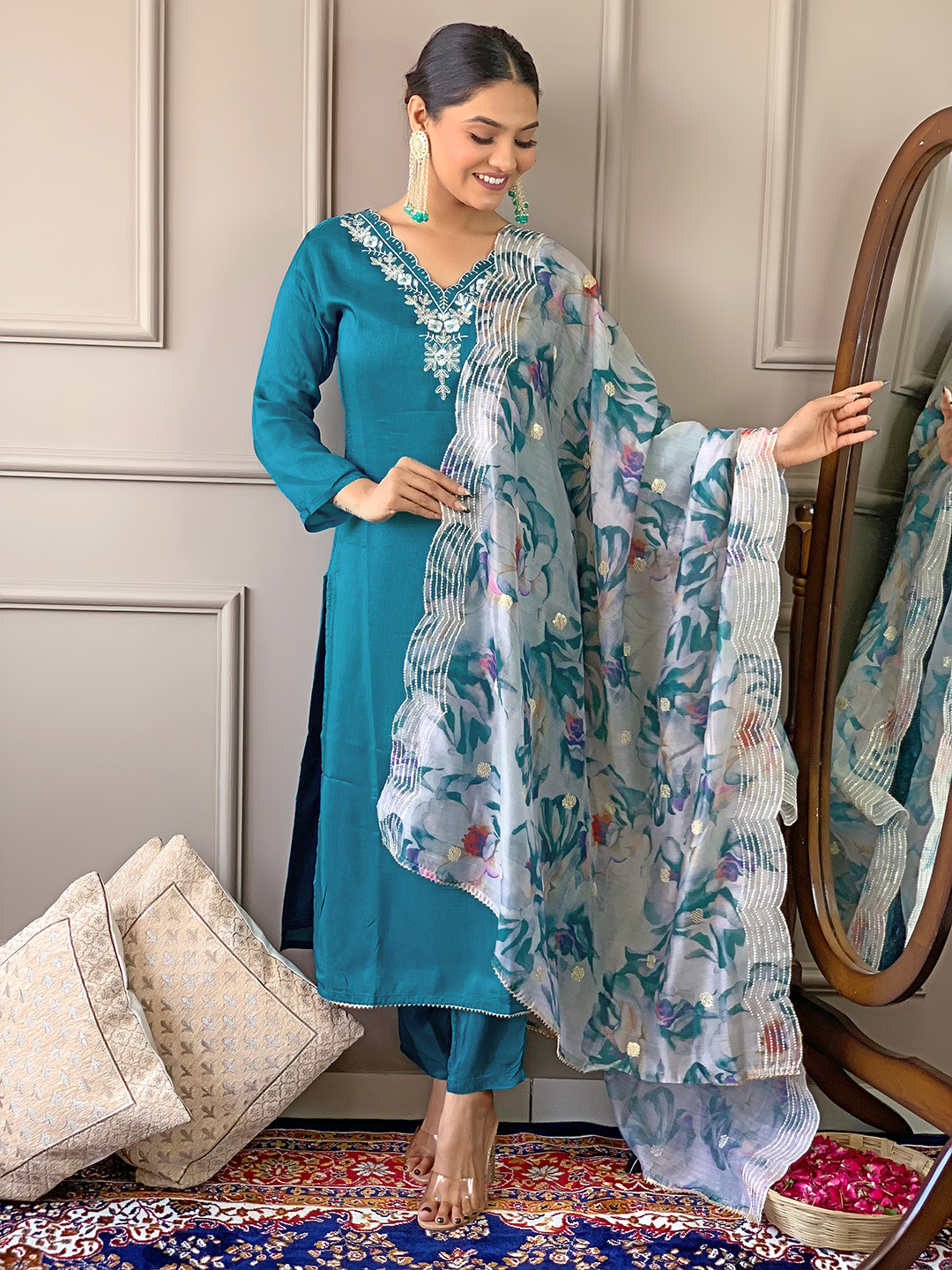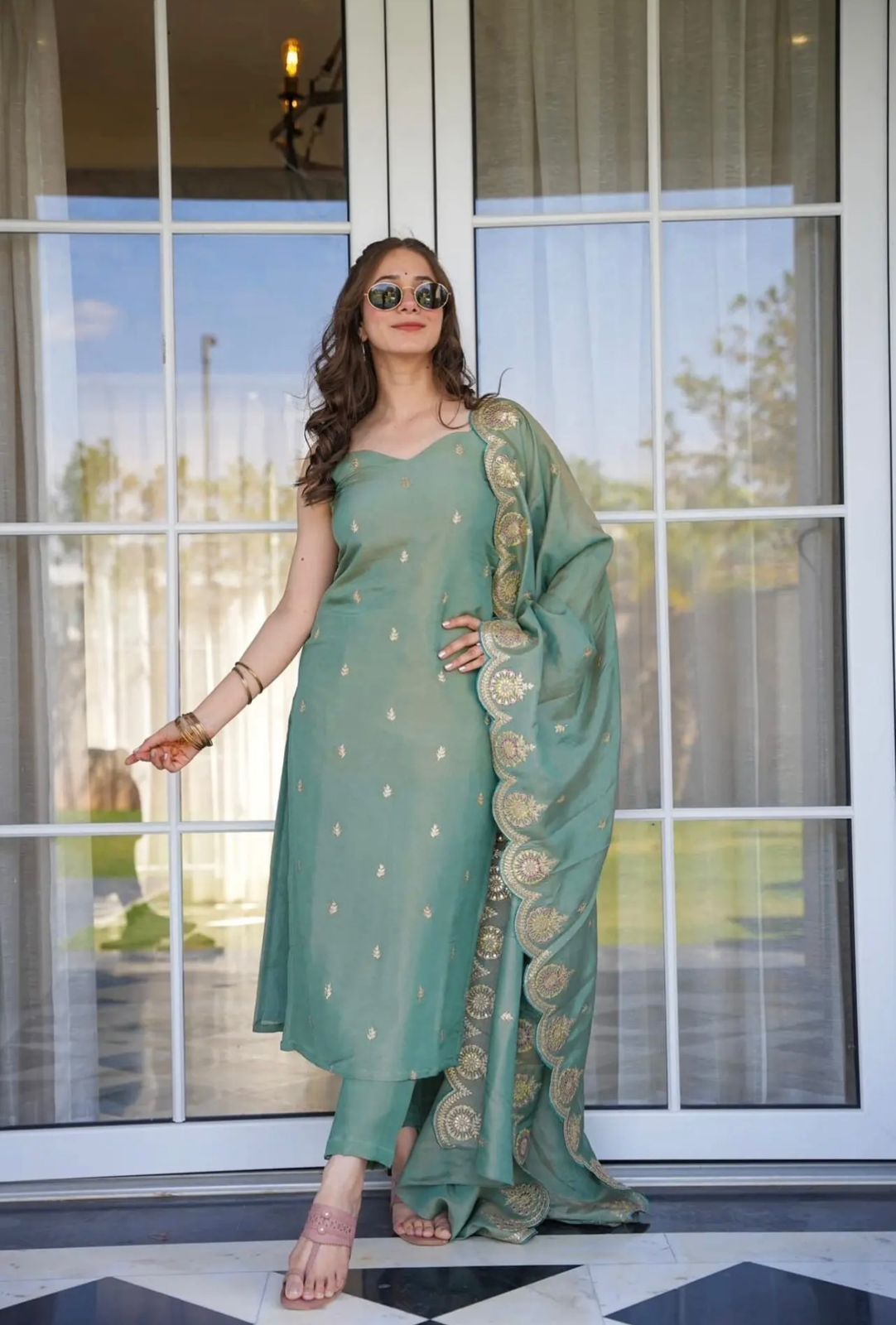
Key takeaways
- No single person discovered or invented the saree; the garment developed gradually from ancient South Asian draped textiles.
- The Indus Valley Civilisation provides evidence of textile use, but surviving artefacts cannot prove that people wore a modern saree.
- The word sari is linked to the Sanskrit term sati, meaning a strip or piece of cloth, although the garment's history is older and more complex than the word.
- The modern saree became more recognisable through regional weaving traditions, stitched blouses, petticoats and changing social customs during the last few centuries.
- Saree identity comes from regional construction, including Banarasi silk, Kanjeevaram, Chanderi, handloom cotton and distinctive pallu designs.
Who discovered saree is a fascinating question, but history doesn't identify one inventor. The saree developed over many centuries from the South Asian practice of wrapping, pleating and draping unstitched cloth around the body. Archaeological evidence, Sanskrit literature, sculpture, regional weaving traditions and colonial-era records each reveal part of the story, but none proves that a single person created the garment.
The most accurate answer is that communities across the Indian subcontinent shaped the saree gradually. Weavers developed new textiles, women adapted drapes to climate and work, courts encouraged luxurious borders, and local customs gave the garment different lengths, pleats and pallus. Understanding who discovered saree therefore means understanding how a living textile tradition evolved rather than searching for a named designer or ruler.
Who discovered saree, and what is the historically accurate answer?
No single person discovered saree because the saree emerged through the gradual evolution of ancient draped clothing in South Asia. The modern garment is the result of changing cloth-making techniques, regional dress practices and social history.
Unstitched clothing has a practical advantage: one length of fabric can be wrapped in several ways, adjusted for movement and reused for different settings. A drape can cover the lower body, pass over the shoulder, create working freedom or become more elaborate for ceremonies without cutting the cloth. That flexibility helps explain why related draped garments appeared across a large and culturally diverse region.
The word sari is commonly connected with the Sanskrit term sati or sati, often interpreted as a strip or piece of cloth. Etymology provides useful evidence about language and textile culture, but a word's history doesn't establish the exact date when the garment began. Ancient people also wore lower garments, shawls and wrapped lengths of cloth that may resemble a saree without being identical to the contemporary six-yard form.
Why the idea of one inventor is misleading
The saree is a clothing system rather than one fixed design. A Bengali saree, a Maharashtrian nauvari, a Gujarati seedha pallu and a Tamil Kanjeevaram may all be called sarees while differing in pleat direction, shoulder treatment, length and fabric.
Regional names also reflect different histories. Kerala kasavu, Assam mekhela sador, Odisha sambalpuri weaving and Andhra ikat traditions demonstrate that Indian draped dress can't be reduced to one origin story. The saree became recognisable through many local innovations, not through a single moment of invention.
What does archaeology tell us about the saree's earliest origins?
Archaeology shows that people in the Indus Valley Civilisation used spun and woven textiles, but archaeological evidence can't confirm that the people of that period wore an up-to-date saree.
Indus Valley sites dating broadly from the third to early second millennium BCE have yielded evidence associated with cotton cultivation, spinning and textile production. Terracotta figurines and carved figures sometimes show wrapped or draped clothing. However, sculptures rarely preserve the detail needed to identify a particular garment, and textiles themselves usually decay in the soil.
Some popular accounts call an Indus Valley female figurine the earliest saree wearer. That interpretation is possible but not proven. A figurine's costume may represent a wrapped skirt, a waist cloth, a ceremonial covering or an artistic convention. Responsible textile history distinguishes between evidence of ancient cloth and proof of a contemporary saree.
Later Indian sculpture offers clearer visual evidence of draped clothing. Figures from Buddhist, Hindu and Jain artistic traditions often show wrapped lower garments and cloths crossing the torso or shoulder. These representations confirm the cultural importance of draping, although artistic images still can't tell us whether every figure represents everyday clothing.
Unstitched cloth and religious practice
Unstitched cloth gained ritual importance in several Indian traditions because it could be woven as one continuous piece and handled without tailoring. Purity rules, ceremonial use and the visual effect of an unbroken textile helped preserve the importance of wrapped garments.
Ritual preference alone did not make the saree. Climate, fibre availability, occupation and regional customs weigh just as much. Cotton was useful in hot regions, silk became important for courtly and formal clothing, and wool or heavier textiles suited colder areas. A saree's history is therefore connected to agriculture, trade, spinning, dyeing and weaving as much as to religion.
How did the ancient drape become the current saree?
The up-to-date saree took shape through the combination of an unstitched drape with stitched garments, regional tailoring and standardised textile production. The familiar combination of saree, blouse and petticoat is historically important, but it was not the only way women wore draped cloth.
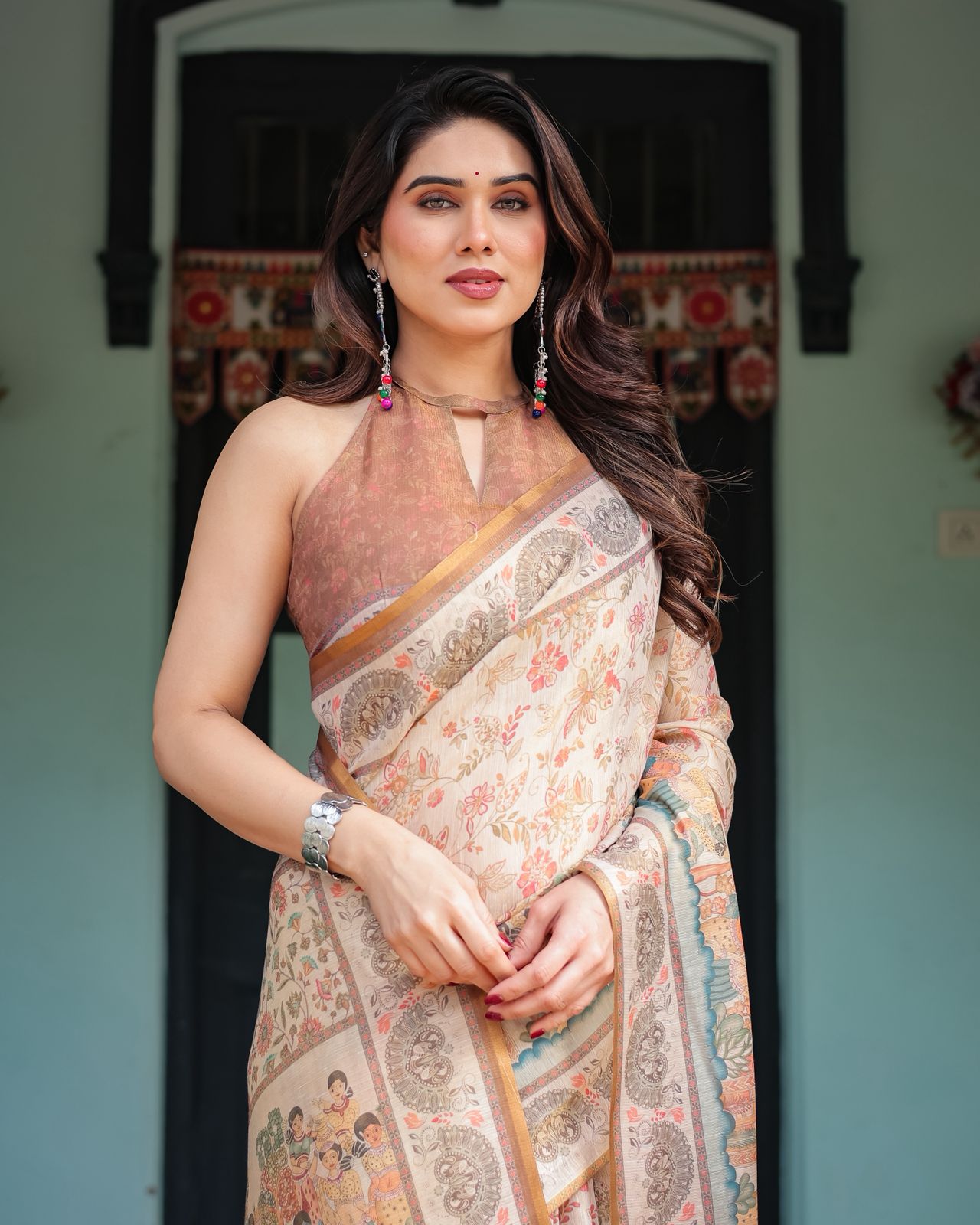
Earlier drapes could leave the upper torso uncovered, use a separate breast band or place the cloth differently around the body. Sculpture and written descriptions suggest considerable variation in how people dressed across regions and periods. The stitched blouse became more widespread in many parts of India during the nineteenth and early twentieth centuries, influenced by changing ideas of modesty, public appearance, tailoring and colonial-era social interaction.
The petticoat also changes how a saree behaves. A firm waist foundation helps hold pleats, while the blouse gives support and coverage at the upper body. Neither garment defines every historical saree, but both became standard in many contemporary wardrobes.
The six-yard saree is common, not universal. Sarees may measure approximately five to nine yards depending on regional practice, fabric width, drape and intended use. A Maharashtrian nauvari, for example, is traditionally longer than many everyday nivi-style sarees because the cloth passes between the legs for greater mobility.
How colonial and postcolonial history changed saree dressing
Colonial-era education, urban employment, photography and public life encouraged more standardised forms of saree dressing. The nivi drape, now widely recognised through its front pleats and shoulder pallu, became especially common beyond its original regional setting.
Printed fashion images, cinema, department stores and later television helped circulate regional styles nationwide. After independence, the saree became both everyday clothing and a visible symbol of Indian identity. Government handloom programmes, state emporia and craft cooperatives further connected named weaving regions with national textile culture.
These changes did not erase older drapes. They created overlapping wardrobes in which one person might wear a cotton saree for work, a silk saree for a wedding and a regional drape for a festival or family ceremony.
Which fabrics and weaving traditions shaped saree history?
Regional fibres, looms, dyes and patterning methods shaped the saree as much as draping did. A saree's identity often comes from the way yarn is spun, the way motifs are inserted and the way the border and pallu are constructed.
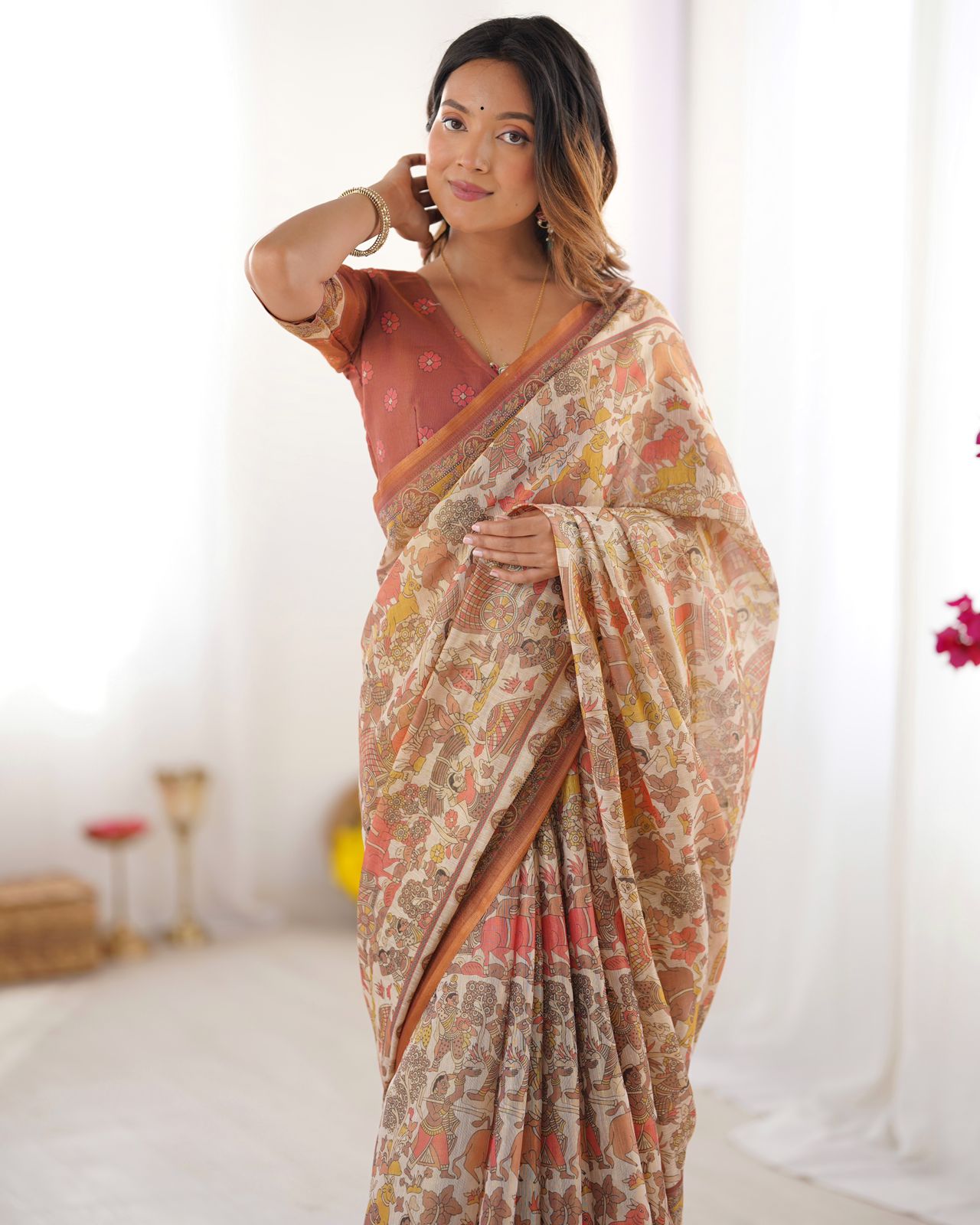
Banarasi silk is associated with Varanasi and is recognised for plush silk grounds, intricate supplementary-weft patterning and zari work. Zari is a metallic thread, traditionally made with precious metal in some historical contexts and commonly made with metal-coated yarn today. Banarasi silk became especially significant for bridal and ceremonial wardrobes.
Kanjeevaram, also called Kanchipuram silk, is known for substantial silk, strong contrast between body and border, and richly woven zari details. The structure of the textile gives Kanjeevaram sarees a distinctive fall and makes them especially durable when stored and handled carefully.
Chanderi, associated with Madhya Pradesh, is valued for its lightness, translucency and blend of silk or cotton characteristics depending on the weave. Chanderi demonstrates why saree history can't be described only through heavy wedding silks: fine, airy textiles have always answered India's climate and social needs.
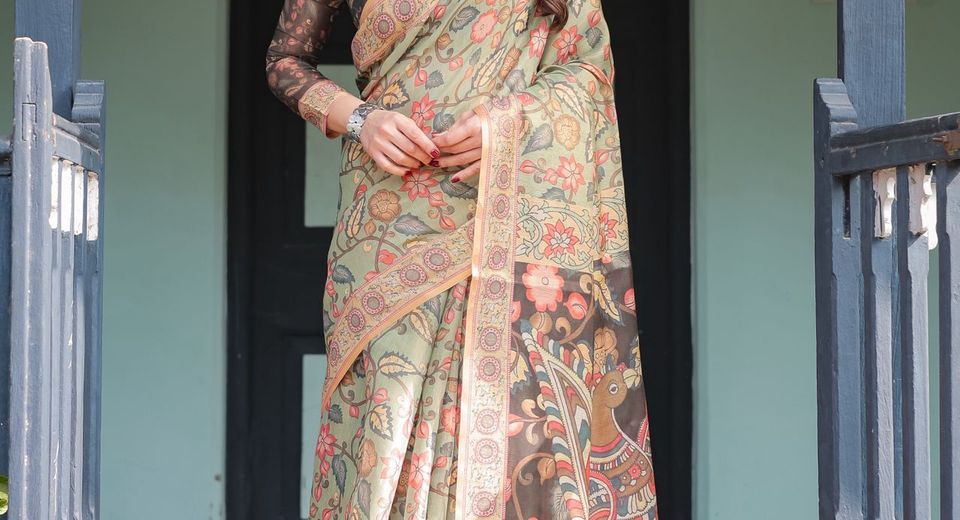
Handloom cottons, linen blends, ikat, kalamkari and jacquard weaving expanded the possibilities further. A textile such as Ethnic Beige Cotton Linen Saree with Village Art Design shows how a contemporary saree can carry a regional-art vocabulary while remaining relatively practical for daytime use.
Reading history through borders and pallus
The border and pallu often reveal a saree's cultural and technical story. Borders may identify a weaving region, signal ceremonial value or provide weight that helps the fabric fall neatly. The pallu can carry figurative motifs, floral arrangements, geometric designs, religious references or family symbolism.
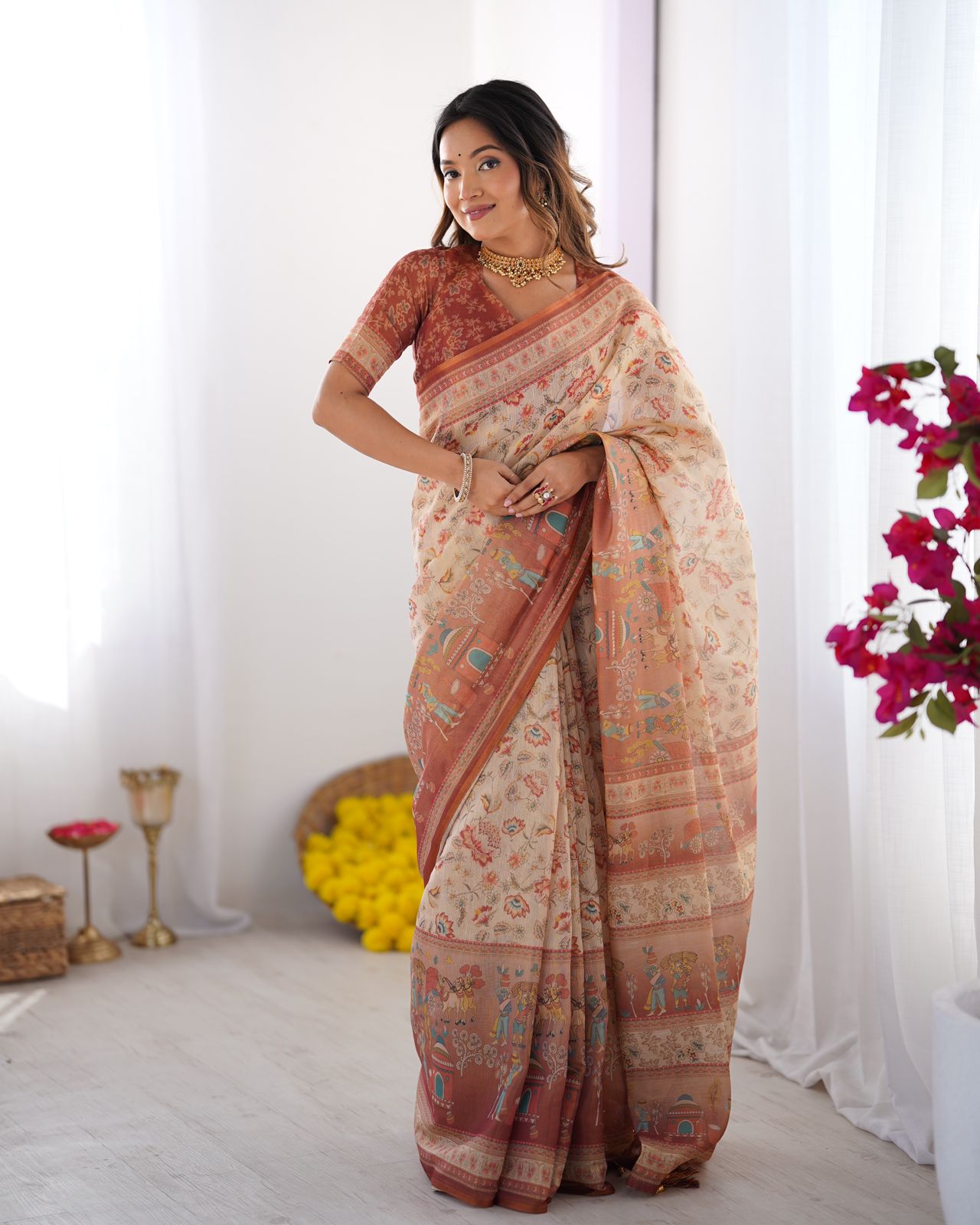
Ivory Rust Handloom Floral Saree with Storytelling Pallu is an useful example of how narrative design can be placed at the end of the drape, where it remains visible over the shoulder. Mustard Olive Handloom Floral Heritage Saree with Pallu similarly illustrates the role of colour contrast and end-panel design in giving a saree a distinct visual identity.
A woven motif isn't the same as a printed motif. Woven designs become part of the textile structure, while printed designs sit on the surface and may respond differently to washing, rubbing and sunlight. Knowing that difference helps a buyer understand both historical technique and care requirements.
Why does the saree look different across India?
The saree looks different across India because draping responds to local climate, work, community identity, fabric availability and ceremonial customs.
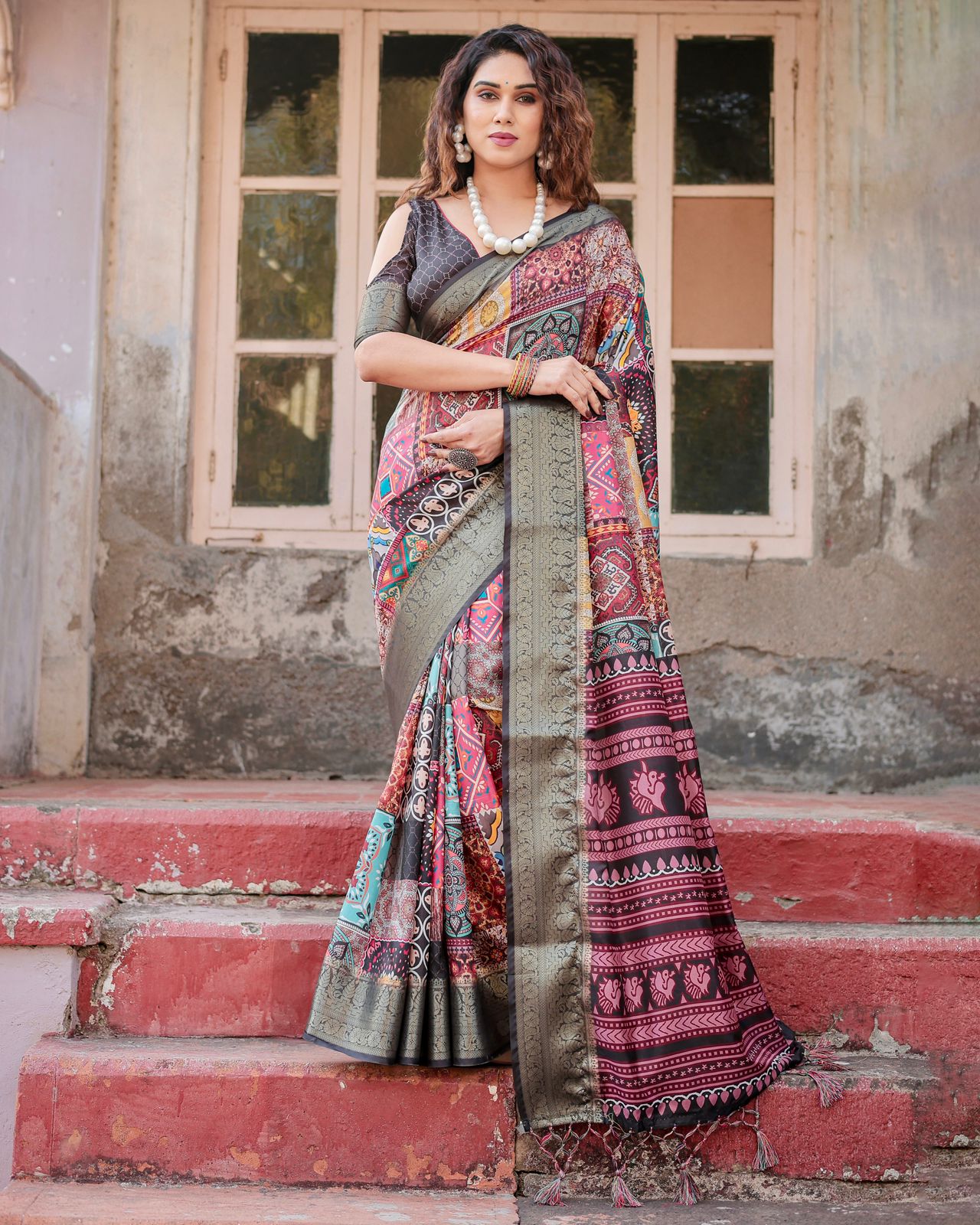
In a hot climate, a breathable cotton saree and a less layered drape may be more comfortable. In agricultural or physically active settings, a shorter or tucked drape can alter movement. In royal and temple contexts, heavier silk, metallic yarn and elaborate borders communicate ceremony. These are not just fashion variations; they're solutions to real social and environmental conditions.
Colour also carries regional and situational meaning. White or off-white with a gold border is strongly associated with Kerala kasavu, while bright silk contrasts are common in many South Indian wedding traditions. Indigo, madder, turmeric yellow, lac red and other natural dye histories connect sarees to local plant resources and craft knowledge, although contemporary production also uses synthetic dyes.
Products such as Heritage Mustard Jacquard Silk Saree and Royal Blue Silk Saree with Exquisite Zari Work demonstrate how modern collections reinterpret two long-standing ideas: patterned silk for visual richness and metallic detail for ceremonial emphasis. The designs are contemporary products, but the design vocabulary belongs to a much longer textile history.
How can you read a saree as a piece of history?
You can read a saree's history by examining its fibre, weave, border, pallu, selvedge, finishing and regional drape rather than judging it only by colour.
- Check the fibre: Cotton, silk, linen and blends have different breathability, weight and care needs.
- Inspect the weave: A handloom textile may show small variations in spacing, selvedge character or motif alignment, while a powerloom fabric often appears more mechanically uniform.
- Study the pallu: A heavily patterned end panel may indicate ceremonial design, narrative imagery or a regional weaving signature.
- Identify zari: Metallic-looking work can be woven zari, embroidered thread, foil or a synthetic substitute; the construction affects both value and care.
- Ask about finishing: Pre-washing, starching, fall stitching and blouse-piece inclusion alter how the saree drapes and how much tailoring is needed.
Price isn't a complete measure of authenticity or historical value. A handloom saree may require more time but use simple cotton, while a machine-made silk-look textile may have elaborate surface decoration. Comparing fibre, construction and workmanship is more useful than relying on the word "traditional" alone.
For readers building a historically informed wardrobe, collections such as Sarees from Rs 1000 to Rs 1500 can be approached as an entry point for comparing fibres and motifs rather than as a shortcut to judging quality. Sarees Under 20% Off and Sarees Under 10% Off may help with budgeting, but discount percentage doesn't establish whether a saree is handloom, pure silk or naturally dyed. Product specifications remain the decisive evidence.
What does the saree mean in contemporary India?
The contemporary saree remains both practical clothing and a carrier of memory, craft and identity. People wear sarees for office days, festivals, weddings, graduations, performances and ordinary household routines, choosing the fabric and drape according to comfort and context.
The saree also supports many forms of personal expression. A wearer may pair a time-honoured silk with a structured blouse, style a handloom cotton with sneakers, or choose a story-rich pallu for a family celebration. Such styling doesn't make the garment less heritage; traditions survive by being used, adapted and taught.
Care determines whether a saree remains wearable across generations. Fold silk sarees with clean, dry hands, refold them every few months to reduce permanent crease stress, and store them in breathable cotton rather than sealed plastic. Keep zari away from moisture, perfume and direct sunlight. Wash delicate handloom cotton, linen and silk according to the maker's instructions, because excessive agitation can distort the weave.
The question who discovered saree ultimately has a collective answer. Ancient textile makers established the material foundation, regional communities refined the drapes, weavers developed distinctive structures, and successive generations gave the garment new social meanings. The saree survives not because it stayed unchanged, but because its continuous cloth can accommodate change.
Frequently Asked Questions
Who discovered saree first?
No individual discovered the saree. The garment developed gradually from ancient South Asian practices of wrapping and draping unstitched cloth, with regional communities shaping the forms recognised today.
Did the Indus Valley Civilisation wear sarees?
The Indus Valley Civilisation used cotton and other textiles, and some figurines show draped clothing. Archaeologists cannot prove that those garments were modern sarees, so the claim should be treated as a possibility rather than a confirmed fact.
What does the word sari mean?
The word sari is commonly linked to the Sanskrit term sati, interpreted as a strip or piece of cloth. The linguistic connection supports the long history of wrapped textiles but does not identify one date or inventor.
Was the saree always six yards long?
No. Six yards is a common modern length, but sarees vary from about five to nine yards depending on regional drape, fabric width and purpose. Drapes such as the Maharashtrian nauvari traditionally require more cloth.
What is the difference between Banarasi silk, Kanjeevaram and Chanderi?
Banarasi silk is associated with Varanasi and ornate patterning with zari, Kanjeevaram is a substantial Kanchipuram silk known for bold borders and ceremonial use, and Chanderi is valued for a light, often translucent handloom character. Fibre composition and exact weave can vary within each category.
How should a historical or handloom saree be stored?
Store a clean, completely dry saree in breathable cotton, away from direct sunlight and dampness. Refold silk and zari sarees every few months, avoid plastic for long-term storage, and follow the specific washing instructions for the fibre and finish.