Where was saree invented?
The saree was not invented by one person in one documented city; the garment developed gradually across the Indian subcontinent from ancient unstitched drapes. The strongest historical answer to where was saree invented is India, particularly the regions connected by early cotton cultivation, textile production and changing draping customs. Archaeology, Sanskrit literature, sculpture and surviving weaving traditions together show a long evolution rather than a single moment of invention.
That distinction matters because the modern saree is one continuous length of cloth, usually about 5 to 9 metres long, worn with a blouse and petticoat or other supporting garments. Ancient Indian clothing did not always use that exact combination. Earlier people wore separate cloths around the lower body, over the shoulders or across the torso, and those pieces gradually became more integrated into recognisable saree drapes.
Historical evidence can't identify an exact inventor or prove that every ancient drape was a saree in the up-to-date sense. Historical evidence can show that unstitched textile garments, cotton weaving and draping practices existed in the Indian subcontinent for thousands of years.
What does archaeology reveal about the saree's beginnings?
Archaeology suggests that the saree's foundations lie in the ancient textile cultures of the Indian subcontinent, but archaeological finds rarely preserve the cloth itself. Cotton fibre decays easily, so historians study spindle whorls, loom weights, textile impressions, figurines, sculptures and the way figures are represented in art.
The Indus Valley Civilisation, which flourished approximately between 2500 and 1900 BCE across parts of present-day India and Pakistan, cultivated cotton and produced woven textiles. Sites such as Mohenjo-daro and Harappa have yielded evidence of spinning and weaving technology. The famous figure often called the Priest-King wears a patterned cloth over one shoulder, although the garment can't confidently be labelled a contemporary saree.
Terracotta figurines from the same broad civilisation show elaborate clothing and waist ornaments, but figurines are stylised and don't provide a complete instruction manual for draping. A carved image or sculpture may represent ceremonial clothing, an idealised body or a local fashion rather than everyday dress.
Archaeology therefore establishes an important foundation: people in the ancient Indian subcontinent had the materials, tools and cultural practice need to make and wear draped textiles. Archaeology doesn't establish that a single saree style existed unchanged from the Indus Valley period to the present.
How did ancient Indian garments become the saree?
The saree evolved from several unstitched and partially stitched garments rather than appearing suddenly in its current form. Ancient Indian clothing was often described through garment categories such as the antariya, a lower-body cloth, and the uttariya, a cloth worn over the upper body or shoulders. The stanapatta or breast band also appears in discussions of early clothing, though terminology and usage varied by period and region.
References to clothing in Sanskrit literature, Buddhist texts and later art show that draped garments were socially meaningful. Fabric, colour, border, ornament and the manner of covering the body could communicate occupation, status, region, ritual role or marital identity. The exact word saree became common much later than the garments that formed its ancestry.
Unstitched cloth had practical and cultural advantages. A single length could be wrapped in different ways, adjusted for movement and reused as a travel or household textile. Unstitched cloth was also important in ritual settings because some communities associated seamless fabric with purity. These meanings were not identical across India, and clothing rules changed over time.
The current saree usually depends on a stitched blouse and petticoat, but those influenced garments became widespread at different times and in different social contexts. Colonial-era dress codes, urban workplaces, photography, schools and changing ideas of modesty all determine how women wore and described the saree. The usual combination of pleats in front, a tucked edge and a pallu over the shoulder is therefore historical, but not timeless or universal.
Where was saree invented according to regional textile history?
The saree has no single regional birthplace because Indian weaving and draping traditions developed in many centres. Bengal, Gujarat, Maharashtra, Tamil Nadu, Andhra Pradesh, Telangana, Odisha, Madhya Pradesh, Uttar Pradesh and Kerala each contributed distinctive fibres, looms, motifs, borders and methods of wearing a long cloth.
Eastern India and the continuity of handloom weaving
Eastern India is central to the history of cotton and silk handlooms, including Jamdani, Tant, Baluchari and Tussar traditions. Bengal's lightweight cotton sarees demonstrate how a breathable woven cloth can become a major regional identity. Bengal's saree history also shows that a textile is defined not only by its silhouette but by the loom, yarn, motif and community that produces it.
Chanderi from Madhya Pradesh offers another useful example. Chanderi fabric is known for a light hand, fine texture and a combination of silk and cotton yarns in many traditional versions. Chanderi sarees are often valued for their translucency and restrained zari work, qualities that connect fabric technology with regional climate and courtly patronage.
Western India and patterned silk traditions
Gujarat and Rajasthan contributed strong patterning, resist-dyeing and double-ikat expertise. Patola is a famous double-ikat textile in which warp and weft threads are resist-dyed before weaving so that the design aligns during construction. The technique requires careful planning because the motif is built into the cloth rather than simply printed on its surface.
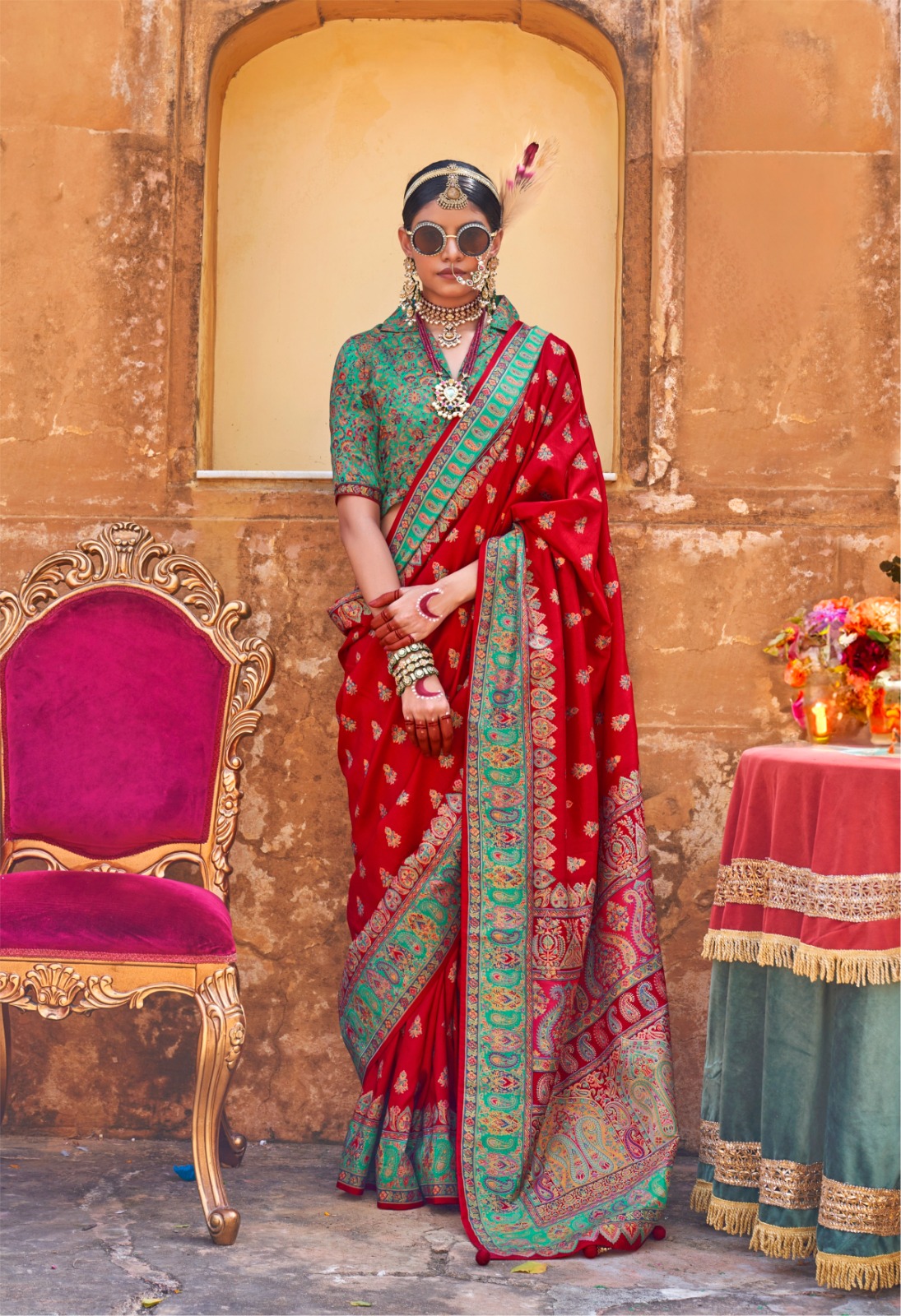
A garment such as Red Patola Border Pashmina Silk Saree With Printed Pallu illustrates how contemporary saree design can combine a classic border vocabulary with a different pallu treatment. The example is useful for understanding that saree history isn't a frozen catalogue; weavers and designers continue to combine regional ideas in new ways.
South India and silk temple traditions
South Indian sarees are strongly associated with silk weaving centres and elaborate borders. Kanjeevaram, also called Kanchipuram silk, is woven in Tamil Nadu and is recognised for its dense silk body, contrasting borders and zari details. Heritage Kanjeevaram weaving often joins body and border through a specialised interlocking technique, creating a durable structure suited to ceremonial wear.
Banarasi silk from Varanasi in Uttar Pradesh is another major Indian tradition. Banarasi silk sarees are known for brocade, supplementary zari work and motifs influenced by flowers, foliage, architecture and historic design exchange. Navy Blue Banarasi Silk Saree with Zari Border and Rani Pink Banarasi Silk Saree with Zari Border show how a classic zari border can remain visually important even when the base colours are dramatically different.
How did weaving technology shape the saree?
Weaving technology shaped the saree by determining its weight, fall, surface texture, durability and decorative possibilities. A cotton handloom can create a cool, breathable cloth for daily use, while silk yarn supports a lustrous surface and heavier brocade. Zari, traditionally made with a metal strip wound around a yarn core and now available in several compositions, adds reflective patterning to borders and pallus.
The difference between a printed motif and a woven motif is especially important. Printing applies colour to an already constructed fabric. Jacquard or supplementary-weft techniques create pattern during weaving. Ikat requires dyeing yarn sections before weaving. Hand-painted Kalamkari applies designs through a surface process, while block printing uses carved blocks to repeat motifs.
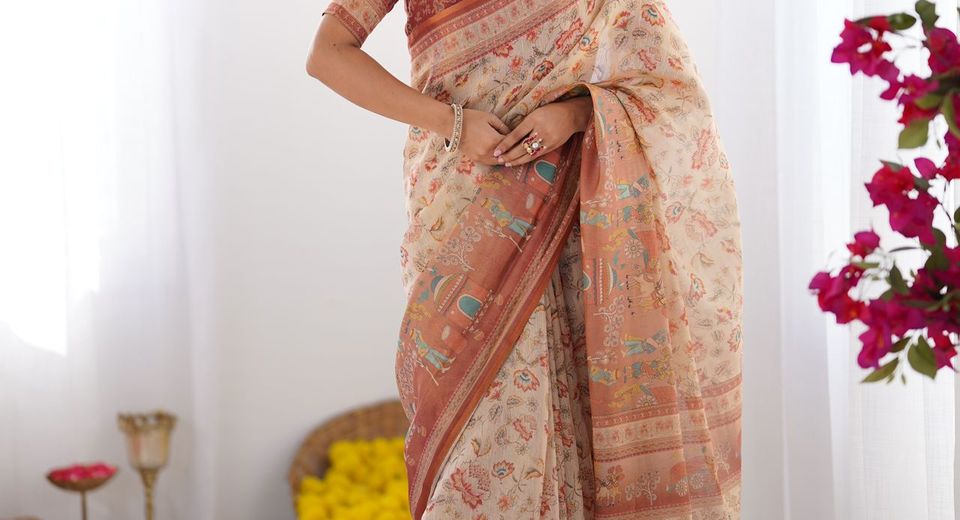
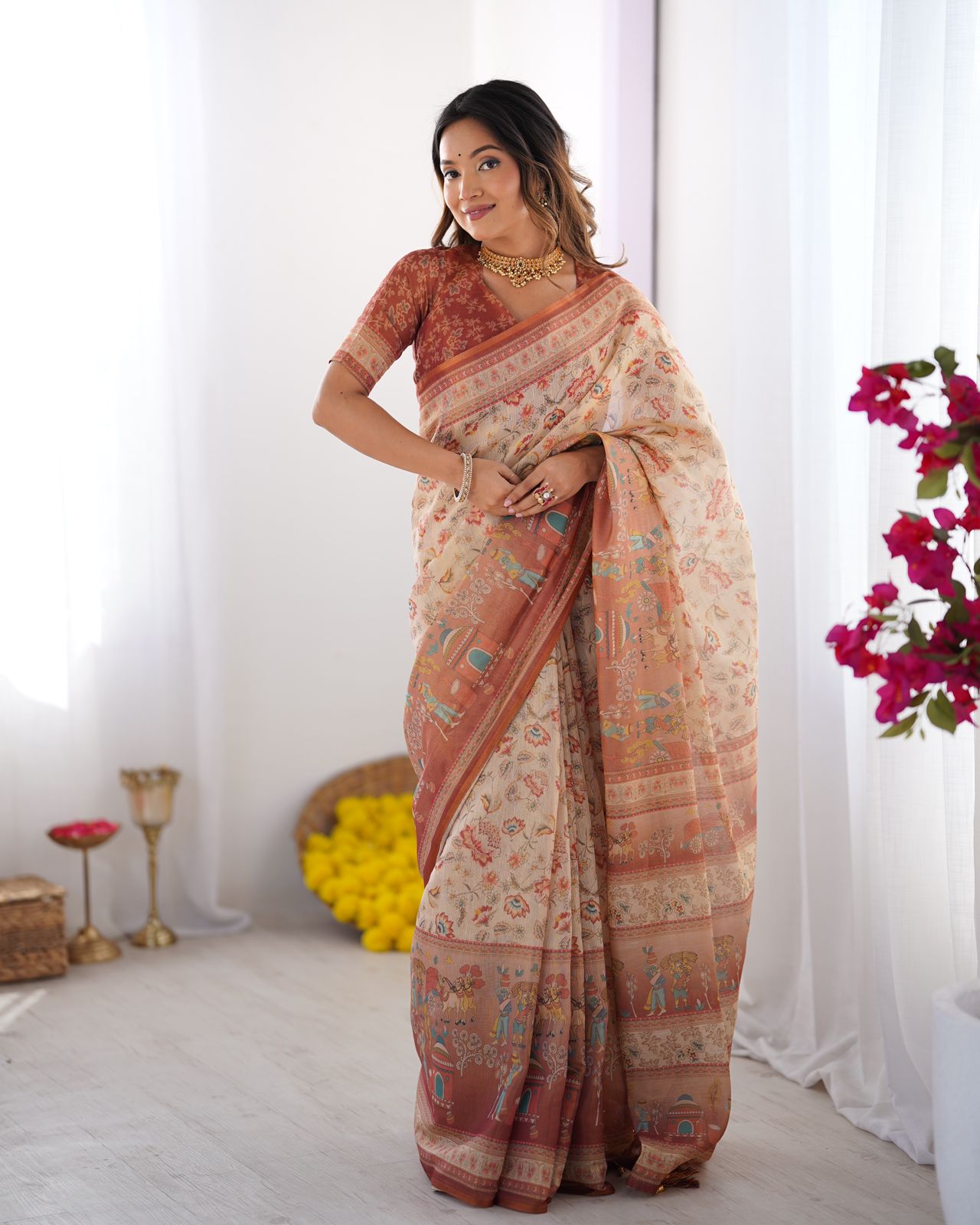
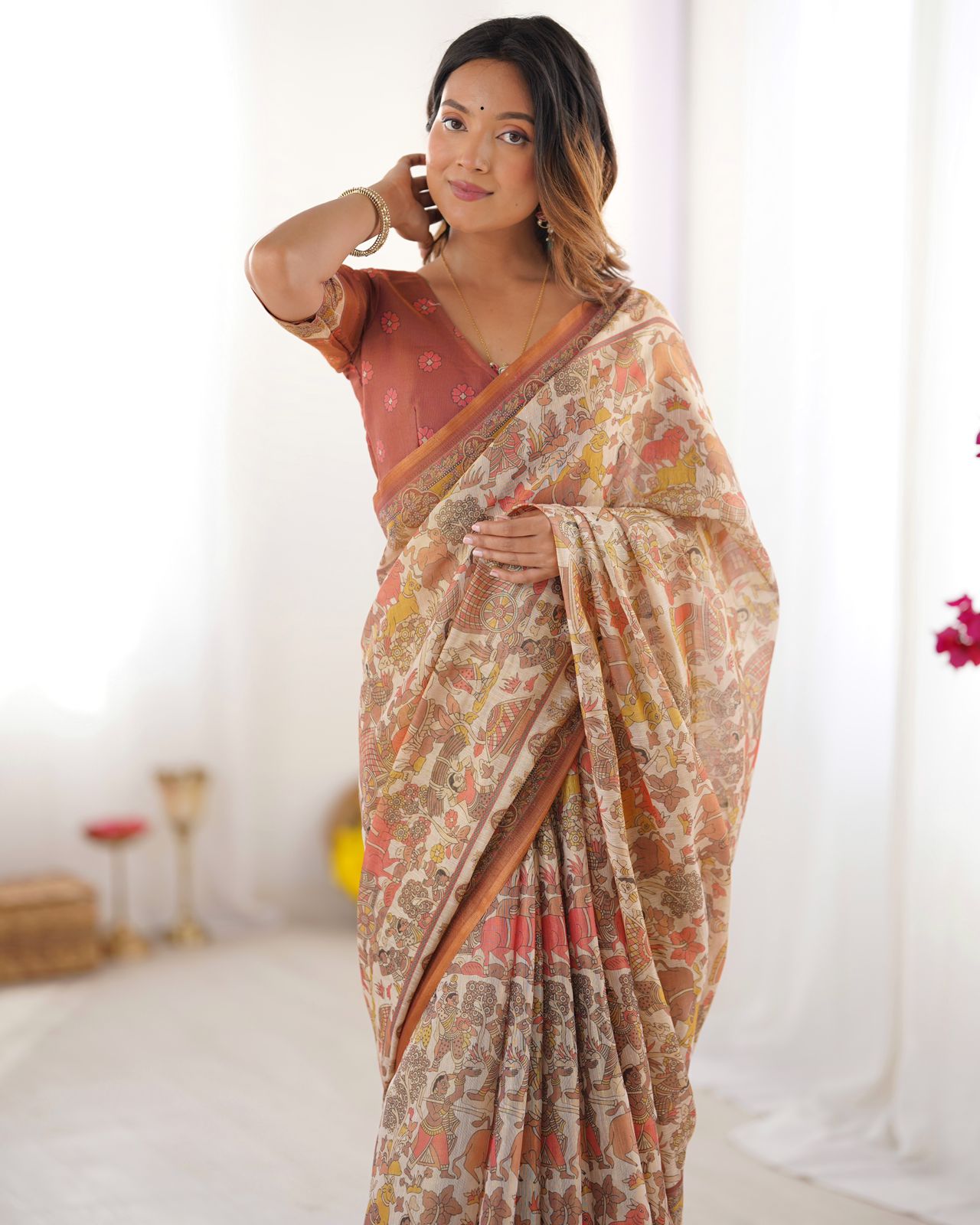
Pastel Floral Tissue Handloom Cotton Saree with Zari Weaves demonstrates how a lighter cotton base can carry a subtle metallic effect without resembling a heavy brocade saree. Ivory Cream Floral Handloom Saree with Heritage Pallu and Ivory Rust Handloom Floral Saree with Storytelling Pallu demonstrate another historical principle: the pallu can function as a visual archive through floral, narrative or heritage-inspired patterning.
Fibre also affects care. Cotton generally tolerates more regular use but can crease and may shrink if washed aggressively. Silk should be protected from prolonged sunlight, perfume and moisture. Metallic zari should not be scrubbed or exposed repeatedly to harsh detergents. Understanding construction is more useful than judging a saree only by colour or price.
Why are there so many ways to drape a saree?
India has many saree drapes because draping developed in response to regional climate, work, upcoming, community identity and local clothing customs. The Nivi drape, usually associated with Andhra Pradesh and Telangana, forms front pleats and places the pallu over the left shoulder. The Bengali drape often apply a broad, pleated pallu and distinctive shoulder arrangement. The Gujarati drape brings the pallu from the back over the right shoulder so that the decorative end adjust in front.
The Maharashtrian Nauvari saree is wrapped in a trouser-like arrangement that supports movement, riding and work. The Kodagu style in Karnataka places the pleats at the back and secures the pallu in a way associated with local tradition. Kerala's settu mundu is usually a two-piece ensemble rather than the same single-piece construction as most sarees, but it belongs to the wider history of draped South Indian clothing.
Drape names should not be treated as rigid rules for every wearer. Regional styles have changed through migration, cinema, weddings, dance, professional life and social media. A person may choose a time-honoured drape for a ceremony and a practical Nivi-style drape for everyday movement without either choice being historically incorrect.
What can today's saree buyer learn from its history?
A historical understanding assist a buyer evaluate a saree by fibre, construction and intended use rather than by the word traditional alone. A handloom cotton saree may be more suitable for a warm daytime event than a heavy silk brocade. A Banarasi silk saree may want careful storage but can be appropriate for a wedding or formal celebration. A linen or cotton-linen saree may offer structure and breathability for office or daytime wear.
Ethnic Beige Cotton Linen Saree with Village Art Design is an example of how regional imagery and natural-looking textures can be carried into contemporary everyday clothing. A village-art motif doesn't automatically prove that a saree was made in a particular historical village, so buyers should distinguish between a design reference and documented provenance.
Price is also not a complete test of authenticity. A low price may reflect simpler yarn, fewer zari details, machine production, a sale, a shorter finishing process or a blended fibre. A higher price may reflect silk quality, skilled labour, complex weaving, natural dyeing or a recognised regional technique. Ask for fibre composition, care instructions, approximate length, blouse-piece details and whether the design is woven, printed or embroidered.
For a practical starting point, shoppers can compare options in Sarees from Rs 1000 to Rs 1500, then examine construction rather than assuming every discounted item has the same value. Promotional groupings such as Sarees Under 20% Off, Sarees Under 10% Off and Sarees Flat 50% Off can help with budgeting, but a discount label doesn't replace information about fabric and workmanship.
Why does the saree remain culturally important?
The saree remains important because it connects an adaptable form of dress with regional textile knowledge, family memory, ritual and personal expression. The same basic length of cloth can communicate restraint through a plain cotton weave, ceremony through Kanjeevaram silk, opulence through Banarasi zari or artistry through an illustrated pallu.
The answer to where was saree invented is therefore less useful when treated as a search for one city or one date. The more accurate answer is that the saree emerged through centuries of Indian textile production and draping, with contributions from many regions and communities. Its history isn't a straight line from an ancient garment to a modern product; it's an ongoing conversation between fibre, loom, body, place and occasion.
That living quality explains why a saree can honour the past without becoming costume. A contemporary wearer can select a handloom floral saree for a daytime gathering, a zari-bordered silk saree for a wedding or a printed pallu for storytelling and still participate in a tradition shaped by continual change.
Common Questions About the Saree’s Indian Origins
Where was saree invented in India?
The saree does not have one confirmed birthplace, but its earliest foundations are associated with the Indian subcontinent. Ancient textile cultures across present-day India and neighbouring regions used cotton, weaving and unstitched draped garments that gradually contributed to the modern saree.
When was the saree first worn?
Draped garments existed in the Indian subcontinent by the time of the Indus Valley Civilisation, around 2500-1900 BCE, but historians cannot prove that people wore the modern saree in its current form at that time. The present-day saree developed through many later regional and social changes.
Is the saree mentioned in the Vedas?
Early Indian texts describe garments and cloth, but they do not provide a simple, universally accepted account of the modern saree. Terms such as antariya and uttariya refer to ancient clothing forms that helped shape later draped dress.
What is the difference between a saree and an ancient unstitched garment?
A modern saree is usually a long continuous cloth worn with a blouse and petticoat or similar supporting garments. Ancient unstitched garments could be separate lower and upper cloths, so they are important ancestors of the saree without being identical to it.
Which Indian sarees are made with zari?
Banarasi silk and Kanjeevaram sarees are two well-known Indian traditions associated with zari work. Zari can appear on borders, pallus or all-over motifs, and its weight and composition can vary between sarees.
Why do saree drapes differ from one region to another?
Regional drapes differ because communities adapted clothing to climate, movement, ritual, local identity and existing garments. Nivi, Bengali, Gujarati, Maharashtrian Nauvari and Kodagu drapes therefore use the same broad garment concept in different ways.