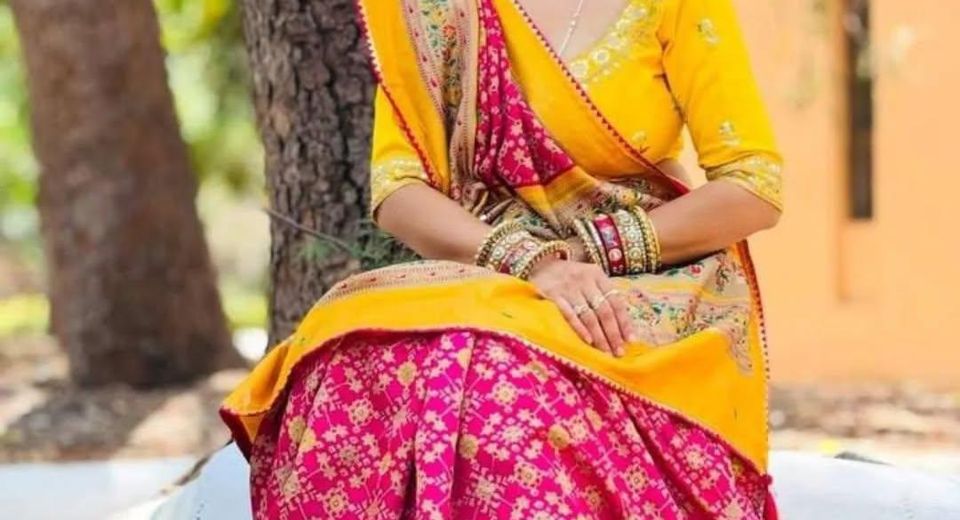
Traditional sarees of Patan are best understood through the craft of Patola, Gujarat's celebrated resist-dyed textile tradition. Patan Patola is associated with precise geometric layouts, jewel-like colour combinations and a demanding double-ikat process in which both warp and weft threads are tied and dyed before weaving. The result is more than a festive garment: it's a textile record of skill, regional identity and patient handwork.
Not every saree carrying a Patola border or Patola print is a handwoven double-ikat Patola. That distinction matters when you're choosing a saree for a traditional wedding, comparing silk qualities or deciding how much care a purchase needs. This guide explains the history, construction, motifs, buying checks and styling choices that make Patan-inspired sarees easier to understand.
What makes Traditional sarees of Patan distinctive?
Traditional sarees of Patan are distinctive because authentic Patan Patola uses double ikat, a resist-dyeing method applied separately to the warp and weft before weaving. The dyed threads are aligned so that colours meet and form a recognisable pattern on both sides of the cloth.
In an ordinary printed saree, colour is applied to the finished fabric or transferred onto its surface. In a single-ikat textile, only the warp or weft is resist-dyed. In double ikat, both directions are prepared in advance. Even a small misalignment can alter a motif, which is why the process demands planning, repeated checking and considerable weaving time.
Patan, in northern Gujarat, is especially associated with the Salvi weaving community and the survival of Patola knowledge across generations. Historical accounts connect Patola to elite patronage and ceremonial use, while contemporary weavers and textile institutions continue to preserve the technique. The word Patola is often used broadly in retail, so a buyer should read descriptions carefully instead of assuming that every Patola-looking design has the same construction.
How is double ikat different from a Patola print?
Double ikat is created by dyeing yarns before weaving, while a Patola print places a Patola-inspired design onto already woven cloth. Both can be attractive, but they differ in labour, texture, price, reversibility and care requirements.
A printed saree can offer an accessible way to wear the visual language of Patan. A handwoven double-ikat saree is a specialised textile purchase whose value lies partly in the alignment of yarns and the time involved in making it. Product descriptions that specify print, weave, handloom, silk composition and zari should be treated as useful evidence rather than decorative wording.
How are Patan Patola sarees made?
Patan Patola is made by preparing, tying, dyeing and aligning warp and weft yarns before the final weaving stage. The process is slow because each colour area must be planned on the yarn, not simply painted onto the finished saree.
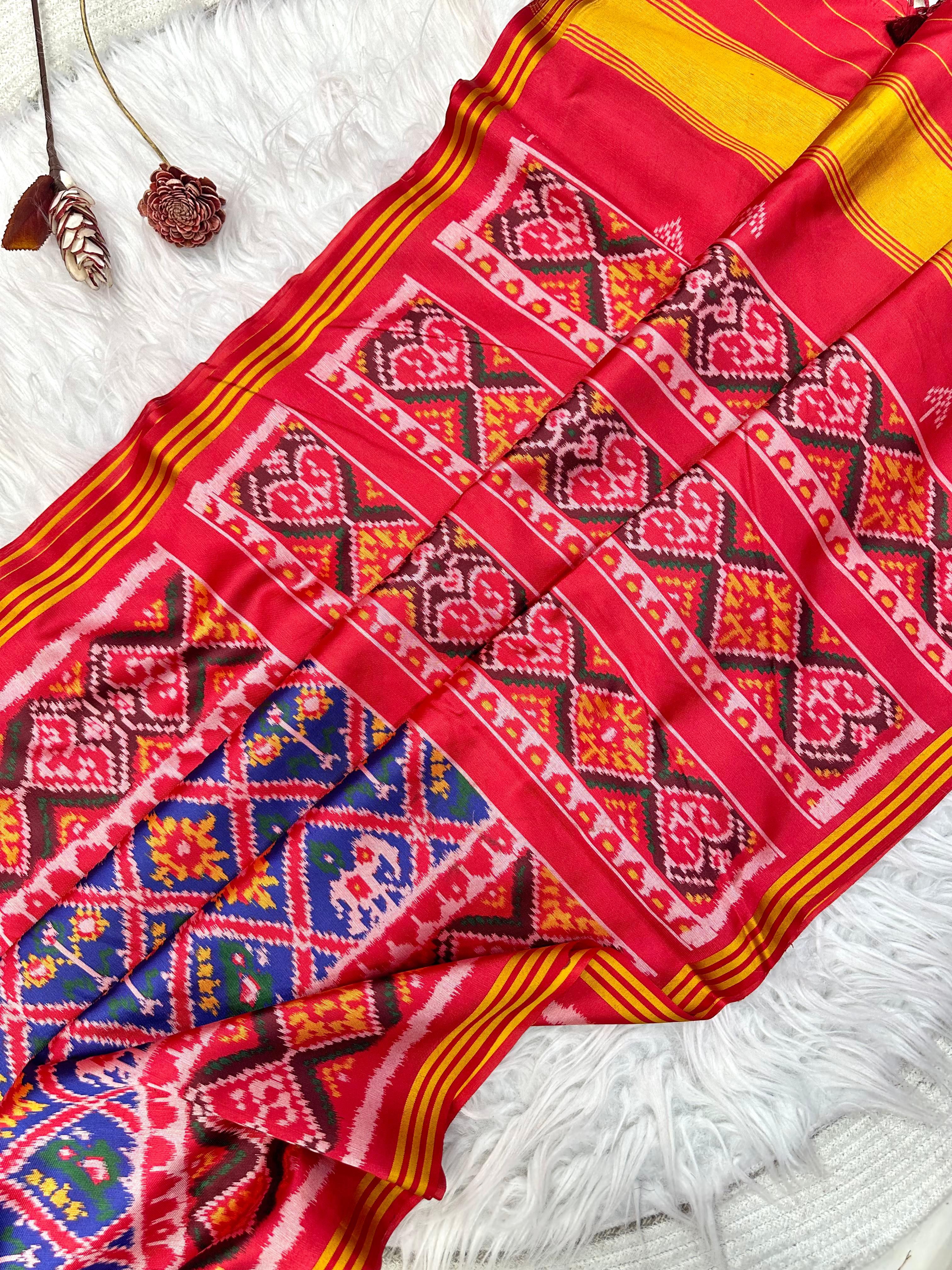
- Design mapping: The weaver plans the motif on a grid so that the intended pattern can be reproduced across intersecting yarns.
- Warp preparation: Lengthwise threads are arranged and selected sections are tightly bound to resist the first dye.
- Weft preparation: Crosswise threads receive corresponding ties and dye sequences. The warp and weft must eventually meet at exact points.
- Layered dyeing: Lighter colours are generally dyed before darker colours, with selected areas repeatedly covered or uncovered to preserve the design.
- Alignment and weaving: The weaver adjusts the yarns during weaving so the pattern appears with controlled edges and balanced repeats.
- Finishing: The completed saree is checked for colour balance, surface condition, selvedge quality and overall pattern continuity.
This construction explains why authentic double ikat may show small variations. A perfectly mechanical appearance isn't automatically proof of quality, and a minor irregularity isn't automatically a defect. The important questions are whether the product is accurately described, whether the motif remains coherent and whether the fabric has been finished well.
Which fabrics, colours and motifs suit a traditional saree?
Silk remains the most recognisable choice for ceremonial Patola, but cotton, linen-cotton blends, tissue cotton and printed pashmina silk can provide different weights and levels of formality. Fabric choice should follow the event, climate and expected wearing time rather than the word traditional alone.
Silk for weddings and formal rituals
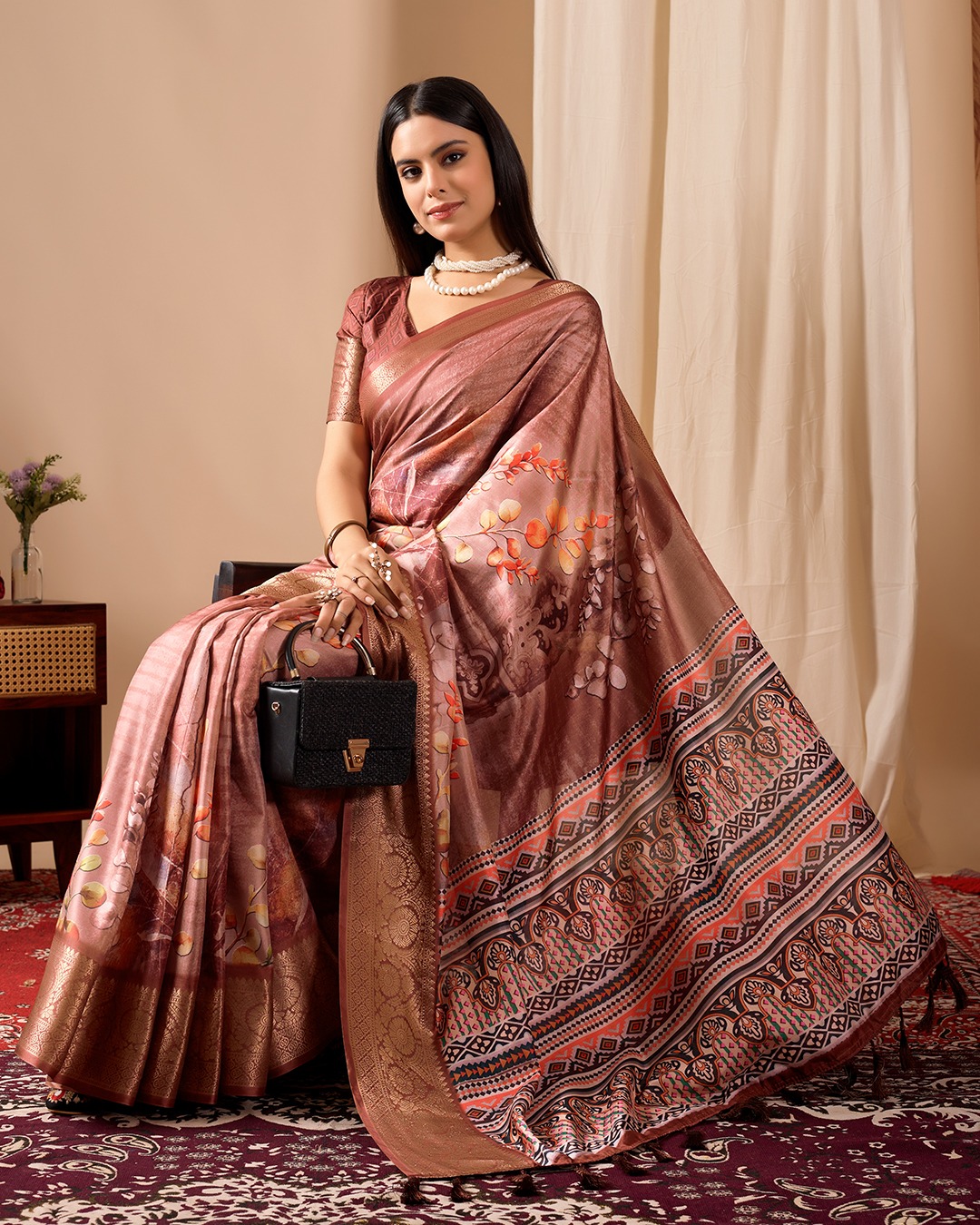
Silk traditional sarees work well for weddings because silk holds a structured drape, supports saturated colour and pairs naturally with zari. A Banarasi silk saree and a Patola-inspired silk saree may both look ceremonial, but their weaving traditions are different: Banarasi silk is known for brocade techniques and zari-rich motifs, while Patan Patola is identified by its ikat construction and Gujarati design vocabulary.
For a formal Gujarati wedding or reception, deep rani pink, red, maroon, emerald, mustard and peacock blue create strong visual presence. A product such as Heritage Peacock Patola Pashmina Silk Saree illustrates how a peacock-led colour story can feel traditional without requiring heavy embellishment. Designer Rani Pink Patola Print Pashmina Silk Festive Saree offers a similar festive direction while clearly signalling a print-based interpretation in its name.
Lighter fabrics for daytime ceremonies
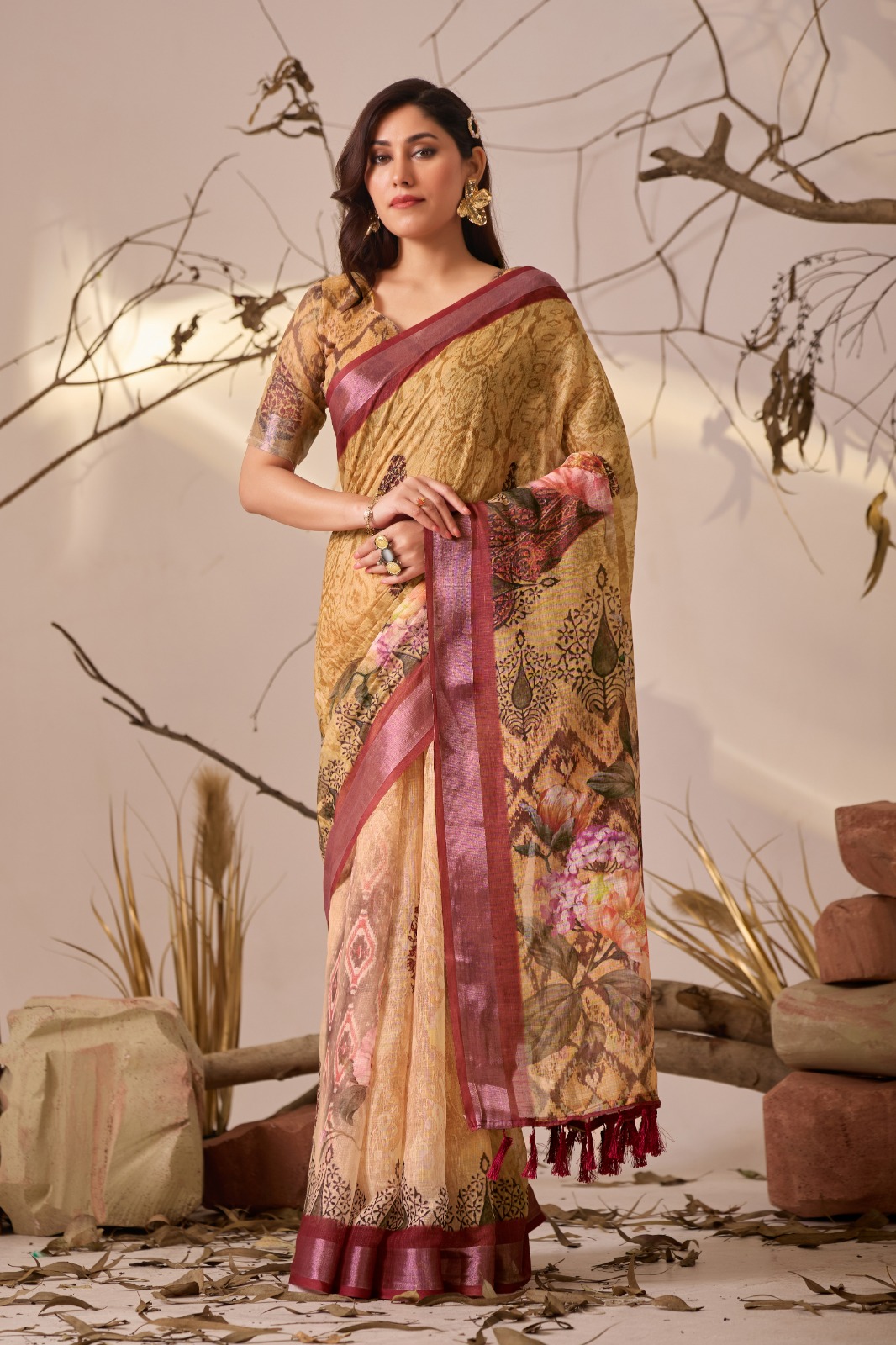
Linen cotton and handloom cotton are practical for daytime pujas, family gatherings and warm-weather celebrations because they usually feel lighter and breathe better than dense silk. Pastel Linen Cotton Floral Print Saree with Designer Blouse and Peach Linen Cotton Floral Print Saree with Blouse for Women suit a softer daytime palette, especially when the blouse and jewellery are kept restrained.
Chanderi is another useful comparison for shoppers seeking a light traditional saree. Chanderi is recognised for its airy handfeel and subtle sheen, whereas a Patola textile is defined primarily by the ikat process and its pattern alignment. Similar lightness doesn't mean identical construction.
Common Patola-inspired motifs
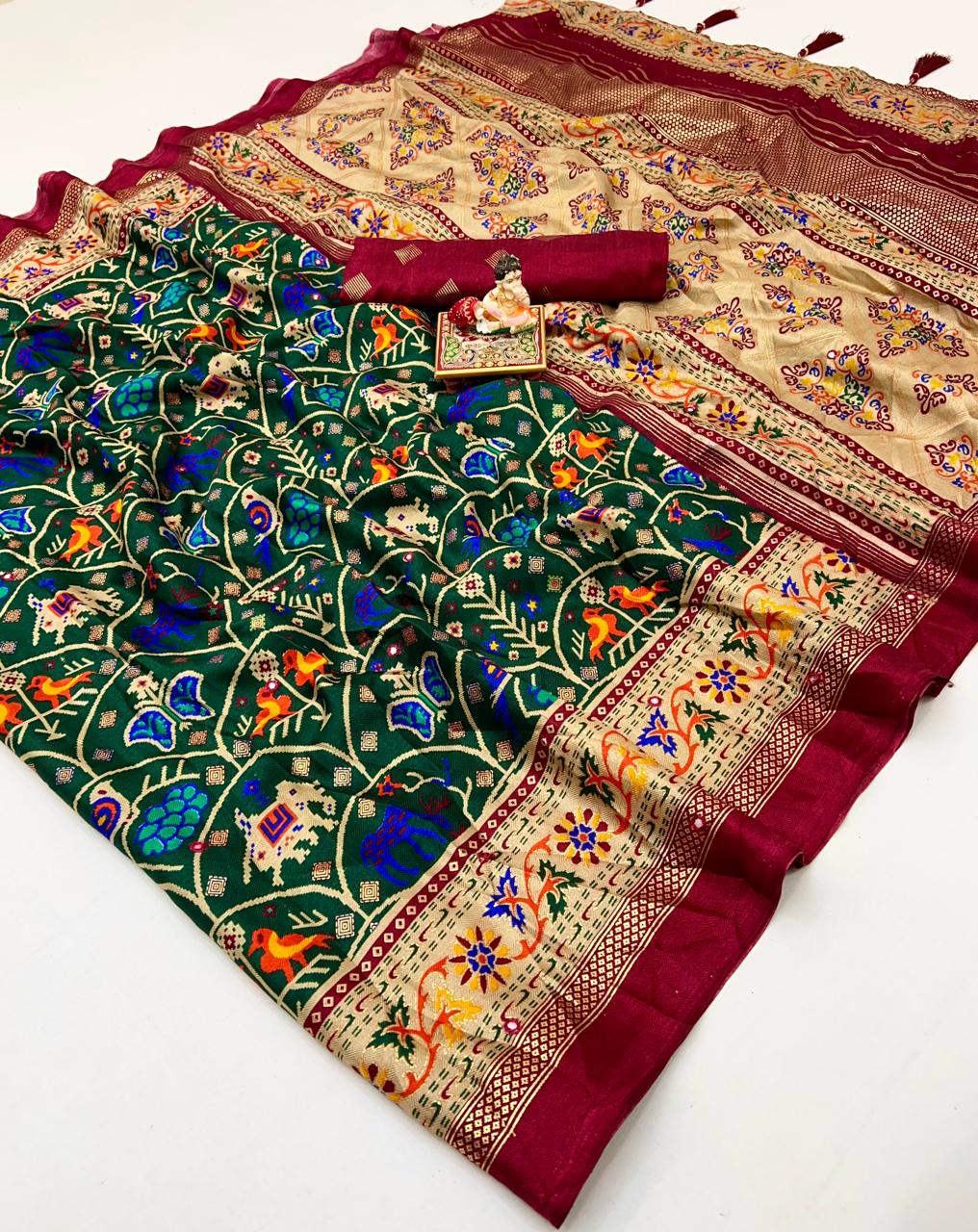
Patola vocabulary often includes geometric repeats, parrots, elephants, flowers, dancing figures, baskets, diamonds and stylised vines. Motifs can carry regional associations, but their presence alone doesn't certify that a saree is handwoven Patan Patola.
Peacock and parrot motifs are especially effective for festive dressing because they create a clear focal point at the pallu. A saree such as Pink Patola Print Pashmina Silk Saree With Mirror Work combines a recognisable Patola-style base with mirror accents, making it more decorative than a restrained everyday interpretation.
How can you identify a suitable Patan saree when shopping online?
You can choose more confidently online by checking the fibre, construction, design method, blouse inclusion, measurements and care instructions before judging colour or price.
- Read the construction term: Look for specific wording such as handwoven, double ikat, printed, Patola print or Patola border. These terms should not be treated as interchangeable.
- Confirm the fibre: Check whether the saree is silk, pashmina silk, cotton, linen cotton or a blend. Fibre affects weight, fall, warmth, sheen and maintenance.
- Inspect the pallu and border description: A Patola border gives a saree a heritage accent, but it doesn't necessarily mean the entire body is double ikat.
- Check measurements: A standard saree is commonly around 5.5 metres, with an additional blouse piece often measuring close to 0.8 metres, but measurements vary. Verify the listing rather than assuming.
- Confirm blouse details: A saree may include an unstitched blouse piece, a designer blouse or no blouse piece. Traditional sarees without blouse fabric can still be styled successfully, but you'll need to budget separately for matching material.
- Study colour information: Screens can shift pink, red, beige and yellow tones. Ask for natural-light images when colour precision matters for a wedding outfit.
- Review care instructions: Silk, zari, mirror work and printed surfaces may require different cleaning methods. A vague care description deserves a clarification before purchase.
Price is another useful clue but not a standalone authenticity test. A handwoven double-ikat Patola typically involves far more labour than a printed Patola-style saree, so unusually low pricing should prompt a closer look at the stated technique. Conversely, a high price doesn't prove authenticity without clear information about fibre, weave and provenance.
How should you style a traditional Patan saree?
A traditional Patan saree looks most balanced when the blouse, jewellery and drape support its motif scale instead of competing with it.
For a traditional wedding
Choose a fitted blouse in a colour drawn from the saree border or pallu. Rani pink with antique gold, peacock blue with gold, and maroon with muted zari are dependable combinations. Wear the pallu in a neat pleated display if the design deserves attention, and use a low bun with jasmine for a clearly traditional finish.
Gold jhumkas, a short necklace and one longer chain are usually enough when the saree already has a detailed border. For a heavier wedding look, add a waist belt or kamarbandh only after checking that the belt won't pull delicate zari or snag mirror work.
For a Haldi ceremony or daytime function
A Haldi ceremony suits lighter cotton, linen-cotton and pastel interpretations with floral or geometric prints. Pastel Floral Tissue Handloom Cotton Saree with Zari Weaves can be styled with a short-sleeved blouse, fabric bangles and comfortable sandals. Keep the pallu secure with hidden pins because turmeric paste, movement and outdoor seating can make an elaborate drape inconvenient.
For a simple traditional look
A simple traditional look needs only a controlled colour palette, a clean pleat and one clear jewellery accent. Traditional Beige Multicolor Printed Saree works well with a plain blouse in beige, rust, green or one of the saree's secondary colours. Avoid matching every accessory to every motif; repeating one colour twice usually appears more deliberate.
For an evening gathering, a Patola-inspired saree can also sit comfortably within Party Wear Sarees, provided the styling remains occasion-appropriate. Mirror work, metallic earrings or a textured clutch can shift a printed silk saree from daytime ethnic wear to festive evening wear without changing the drape.
Where do Patan sarees fit among Indian traditional sarees?
Patan Patola belongs to Gujarat's textile heritage, but it sits within a wider Indian saree landscape that includes Kanjeevaram, Banarasi, Chanderi, Kasavu, Paithani and Kalamkari traditions. Each name refers to a different combination of region, material, technique and visual language.
Kanjeevaram is strongly associated with South Indian silk weaving and substantial zari borders. Banarasi silk often features brocade structures and metallic patterning from Varanasi. Chanderi is valued for its light, translucent quality. Patan Patola is distinguished by the double-ikat preparation of yarns and the resulting precision of repeated motifs.
These distinctions make collection browsing more useful when used as a comparison rather than a ranking exercise. White Silk Sarees in Cream Ivory and Off White may be appropriate when you want a quieter ceremonial base, while Maroon Silk Sarees with Up to 74% Off can help locate a richer wedding palette. Red and Yellow Sarees from Rs 799 with Up to 75 Percent Off speaks to bright festive dressing, but price and colour grouping don't reveal whether an individual saree is woven, printed or embellished.
For shoppers building a versatile wardrobe, one printed Patola-inspired saree can cover festivals and family events, while one documented handwoven silk saree can serve as a long-term heritage purchase. The right choice depends on how much you value technique, how often you'll wear it and whether you need easy maintenance.
How should Patola-style sarees be stored and cared for?
Patola-style sarees should be stored clean, dry, loosely folded and protected from direct sunlight. Care should follow the actual fibre and embellishment rather than the appearance of the saree.
- Dry-clean silk, pashmina silk, zari-rich sarees and mirror-work sarees unless the care label specifically permits another method.
- Air a saree after wearing before folding it away, especially after a humid event or prolonged contact with perfume and perspiration.
- Refold silk and zari sarees every few months so permanent fold lines don't form in one place.
- Wrap delicate sarees in clean cotton or acid-free tissue; avoid storing them directly against damp wood, plastic or newspaper.
- Keep zari away from moisture and harsh chemicals. Apply perfume and hairspray before draping, then allow them to dry.
- Use a broad hanger only briefly. Long-term hanging can stretch the fabric, especially when the saree is heavy.
Linen cotton may crease more readily than silk, but pressing at a moderate temperature with a protective cloth can restore its appearance. Printed surfaces should not be scrubbed, and mirror work should be kept away from rough jewellery that can catch the thread or embellishment.
How do you choose between heritage and convenience?
Choose a documented handwoven Patan Patola when the making technique, long-term value and textile history matter most; choose a printed or blended Patola-inspired saree when accessibility, lighter care and styling flexibility matter more.
Both choices can be respectful of traditional dressing when the description is understood accurately. A printed saree doesn't become less useful because it's not double ikat, and a handwoven saree doesn't become better suited to every event simply because it's more labour-intensive.
Before buying, write down three priorities: the event, the acceptable maintenance level and the fabric weight you can comfortably wear for several hours. That short checklist will usually narrow the choice more effectively than searching only by colour or discount.
Questions to Ask Before Buying a Patan-Inspired Saree
What are the most traditional sarees associated with Patan?
The Patan saree most strongly associated with Gujarat is Patola, especially double-ikat Patola woven by preparing and dyeing both warp and weft yarns before weaving. Printed Patola-style sarees and sarees with Patola borders interpret the same visual tradition but are not necessarily handwoven double ikat.
How can I tell whether a Patola saree is authentic?
Check whether the description clearly states double ikat, handwoven construction, fibre, origin and maker or artisan details. Pattern appearance alone cannot prove authenticity, so request close images of the front and reverse, ask about the weave, and be cautious when the listing uses Patola only as a colour or print label.
Are Patan Patola sarees suitable for a traditional wedding?
Yes, Patan Patola sarees are highly suitable for traditional weddings because their geometric motifs, strong colours and silk options create a ceremonial look. Choose a structured silk drape for the main wedding and a lighter cotton or linen-cotton interpretation for a daytime function or family event.
Can I wear a traditional saree without a blouse piece?
Yes, a traditional saree without blouse fabric can be worn with a separately tailored blouse in a border, pallu or secondary colour. Confirm the saree measurements and match the blouse fabric by weight, because a very heavy silk blouse may pull a lightweight cotton or linen-cotton saree.
Which fabrics are easiest for a simple traditional saree look?
Linen cotton, cotton and lighter handloom fabrics are generally easier for a simple daytime traditional look because they are comfortable and less visually heavy than dense silk. Silk and pashmina silk are better choices when you want a richer drape for a wedding or evening celebration.
Where can I buy traditional sarees online in India?
Buy from a website that gives specific information about fibre, weave or print method, saree and blouse measurements, care instructions and delivery details. For Patan-inspired sarees, compare the product description carefully so a printed Patola design is not confused with a handwoven double-ikat Patola.