Telangana Pattu Cheera and the Distinction Between Silk and Ikat become easy to understand once fibre and patterning method are separated. Silk describes what a yarn is made from, while Ikat describes how yarns are resist-dyed before weaving. A Telangana saree can therefore be made from silk, carry an Ikat design, and go to both categories at the same time.
That difference matters when you compare a Pochampally Ikat saree with a plain silk drape, read an online description, or decide how a saree should be stored. Telangana weaving traditions include silk, cotton and linen textiles. The same geometric language may appear across several fibres, so colour and motif alone can't establish whether a saree is silk or genuinely woven Ikat.
Telangana Pattu Cheera and the Distinction Between Silk and Ikat: What Does Pattu Cheera Mean?
Telangana Pattu Cheera generally means a Telangana silk saree, but the phrase doesn't identify one compulsory weave, silk variety or motif. "Pattu" means silk in several South Indian textile contexts, while "Cheera" means saree in Telugu usage. The phrase therefore points to a silk-oriented saree category rather than a single standard construction.
Telangana has important weaving centres including Pochampally, Gadwal and Narayanpet. Pochampally is strongly associated with Ikat, Gadwal is recognised for distinctive silk-cotton structures and contrasting borders, and Narayanpet sarees often feature compact weaves, borders and repeated motifs. These regional identities can overlap in modern retail, so a careful description should state the fibre, technique and place of production separately.
A Telangana Pattu Cheera may use mulberry silk, Tussar silk, a silk blend or silk in combination with another material. The word "pattu" by itself doesn't prove that every part of a saree is pure mulberry silk. Fibre content, zari composition, blouse-piece details and care instructions deserve separate attention.
Telangana Pattu Cheera and the Distinction Between Silk and Ikat: How Do the Terms Differ?
Silk names a natural protein fibre, whereas Ikat names a resist-dyeing process used to create patterns on yarns before weaving. Silk comes from silkworm filaments or fibres; Ikat is produced when selected portions of warp yarns, weft yarns or both are tied or protected before dyeing.
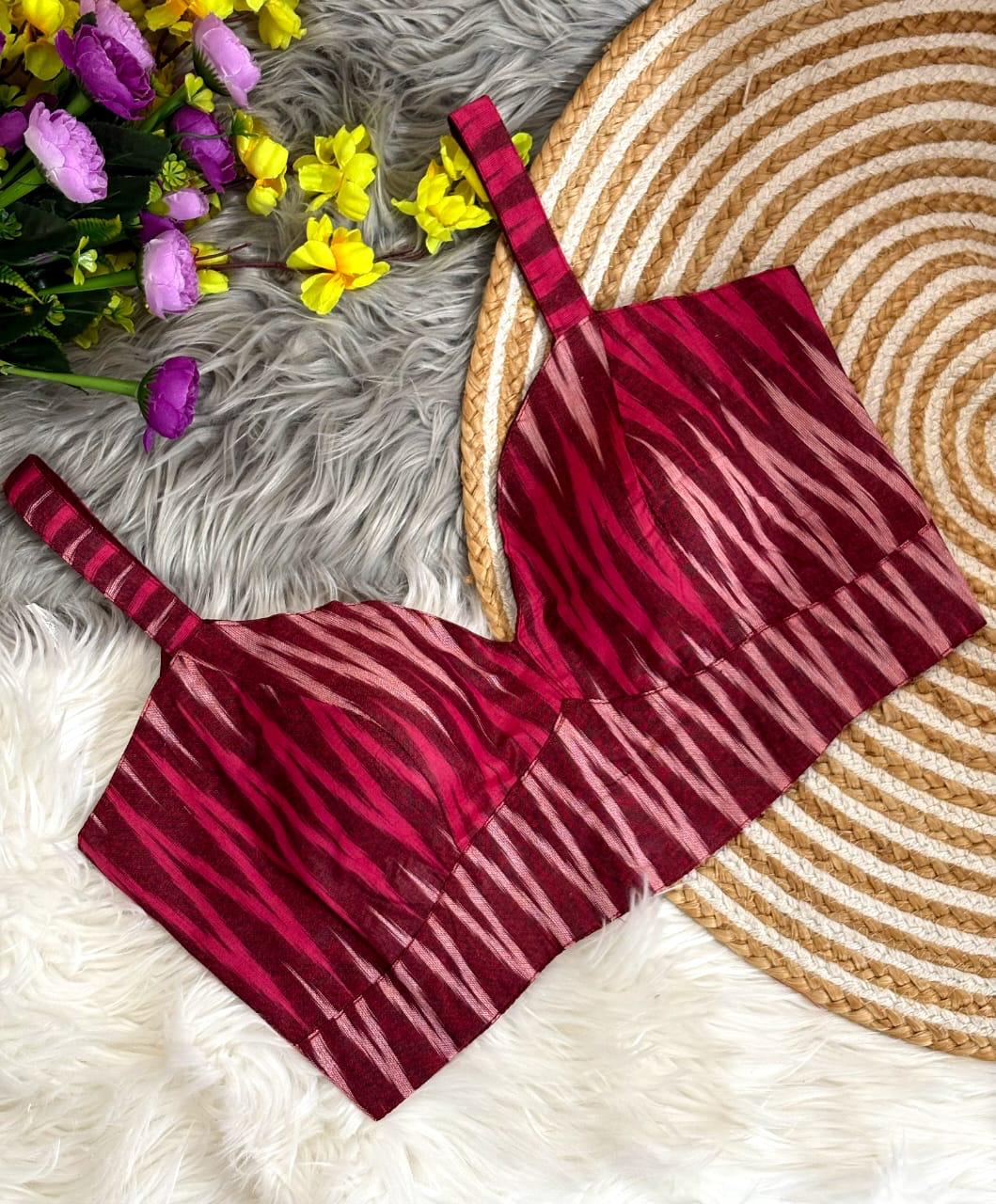
In a printed silk saree, the cloth is woven first and the design is placed on its surface afterwards. In a silk Ikat saree, the pattern is planned on yarns before those yarns enter the loom. The finished design often has softly feathered edges, slight alignment shifts and a rhythmic, pixel-like appearance because dyed yarn sections meet during weaving.
Warp Ikat patterns the lengthwise yarns, weft Ikat patterns the crosswise yarns, and double Ikat patterns both sets. Double Ikat demands especially careful alignment because the motif depends on two pre-dyed yarn systems meeting accurately. Pochampally is widely known for sophisticated Ikat traditions, including geometric designs that require substantial preparation before weaving begins.
- Silk: a fibre with natural lustre, a characteristic handle and different qualities according to its variety and finishing.
- Ikat: a yarn-resist technique in which selected yarn sections are protected and dyed before weaving.
- Silk Ikat: a saree that uses silk yarn and receives its pattern through Ikat preparation.
- Ikat print: a surface print that resembles Ikat but doesn't necessarily involve resist-dyed yarns.
The phrase "Ikat print" should therefore not be treated as identical to "woven Ikat. A printed design may be attractive, durable and affordable, but it represents a diverse production process from handwoven Pochampally Ikat.
Telangana Pattu Cheera and the Distinction Between Silk and Ikat: Why Is Pochampally Important?
Pochampally is important because the region developed a distinctive Telangana tradition of yarn-resist weaving that made Ikat a recognised part of the area's textile identity. Diamonds, stepped forms, chevrons, checks and repeating bands are common visual references, although contemporary Pochampally designs also include florals, abstract forms and simplified patterns.

Ikat production begins with design planning rather than surface decoration. Yarn sections are measured, tied or otherwise protected, dyed in sequence, opened and arranged on the loom. Every additional colour can require another stage of resist preparation. The weaver then aligns the yarns so that the intended motif emerges as the warp and weft intersect.
This process explains the softened outline often seen in Ikat. A handwoven pattern may contain controlled variations in alignment, particularly where complex motifs meet. Such variations can be evidence of yarn-dyeing and handloom work, but irregularity alone can't certify that a saree is handmade. A reliable product description should still state whether a saree is handwoven, powerloom-made, printed or made with a combination of techniques.
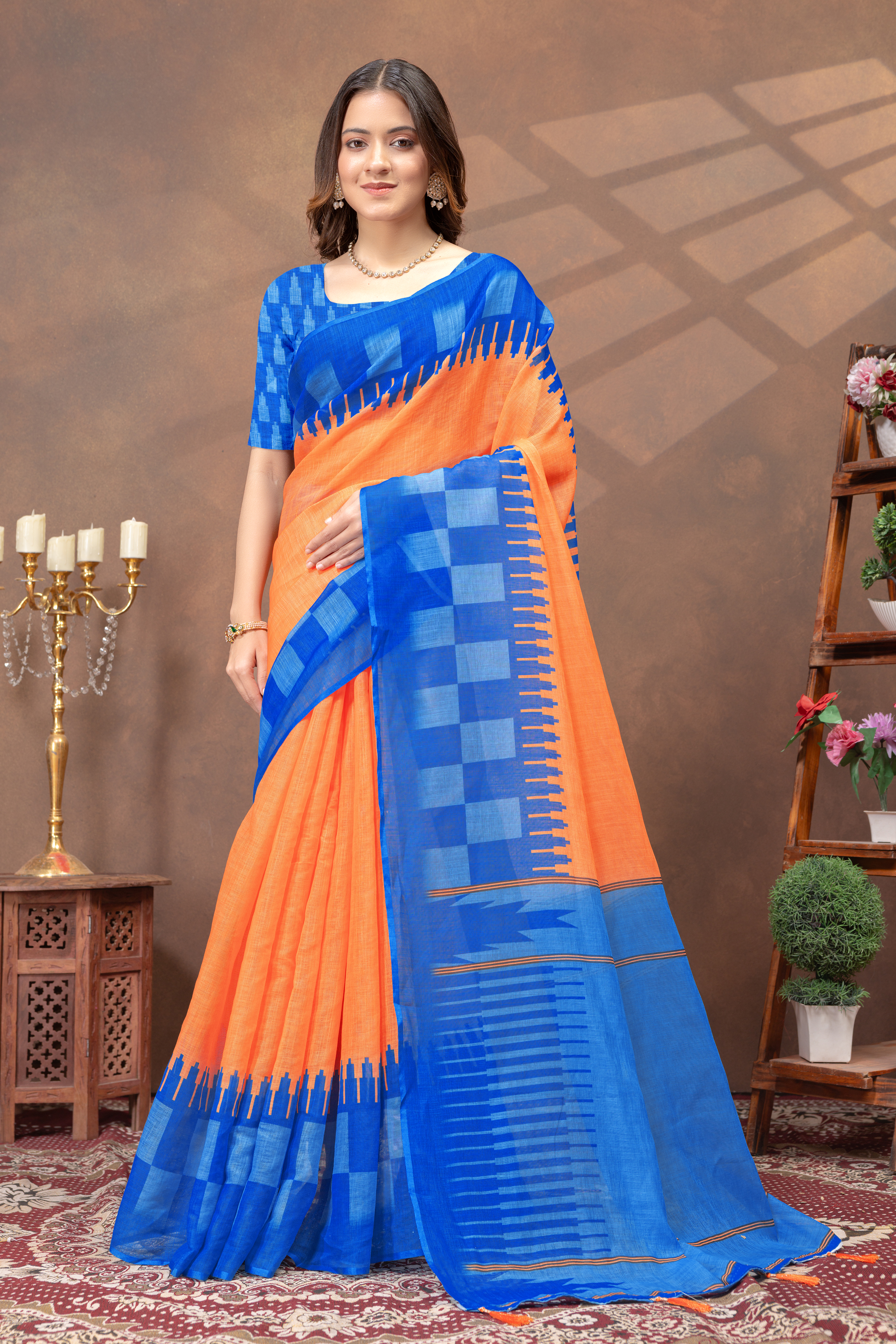
Royal Blue Green Chanderi Cotton Ikat Print Saree for Women shows why fibre and pattern treatment should be read as separate details. Chanderi cotton identifies the textile base, while Ikat print identifies the visible design treatment. Neither phrase indicates pure silk or automatically confirms handwoven Pochampally Ikat.
Telangana Pattu Cheera and the Distinction Between Silk and Ikat: How Can You Check a Saree?
You can assess a saree by combining the fibre label, pattern description, reverse-side appearance, drape and construction details. No single home test proves silk purity or handloom origin, so product information and physical inspection should support each other.
Read the fibre label carefully
A description that says mulberry silk, Tussar silk, art silk, silk blend or polyester gives more useful information than the word "silk" alone. Mulberry silk is generally smoother and more uniform, while Tussar silk often has a subtly textured surface and a less regular lustre. A blend can be practical and economical, but the percentage of each fibre should be disclosed whenever possible.
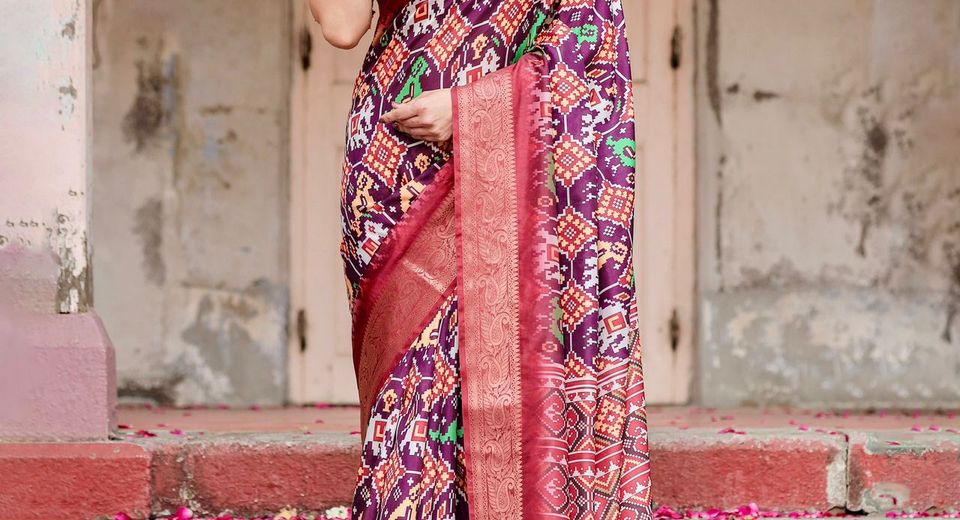
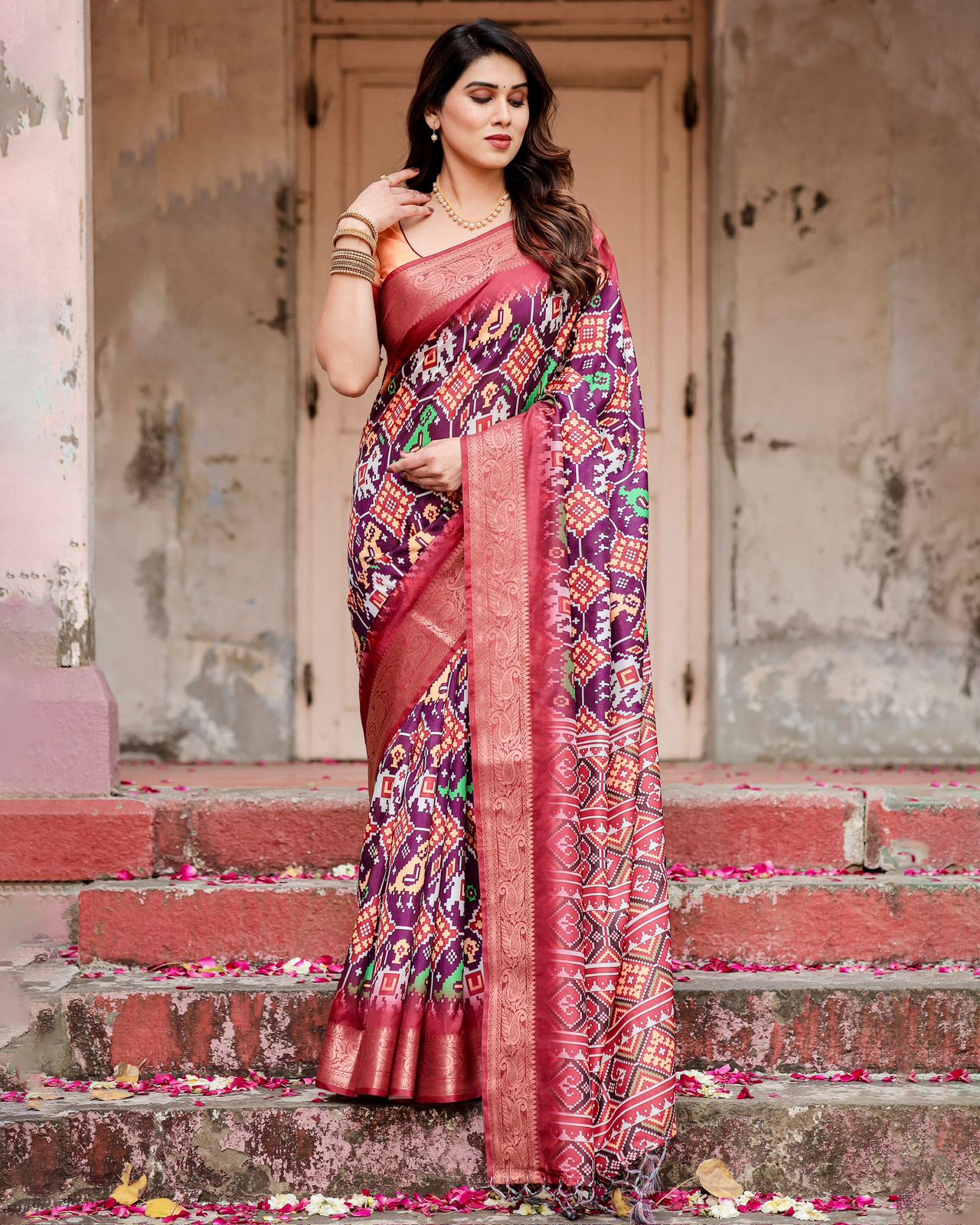
Royal Purple Tussar Silk Saree with Traditional Ikat Print illustrates how two descriptions can coexist: Tussar silk identifies the fibre, and traditional Ikat print identifies the pattern treatment. The word "print" indicates that the saree should not automatically be described as yarn-dyed woven Ikat.
Examine the front and reverse
A woven Ikat pattern generally exists within the yarn structure, so the design remains visible on the reverse, although the reverse may look less intense. A surface print can appear stronger on the front and may show differences in colour density or printing around the edges. Dense weaving, finishing and zari can make this comparison difficult, so the reverse-side check is useful but not conclusive.
Look closely at where diamonds, stripes or chevrons meet. Small controlled shifts can occur in handloom Ikat because pre-dyed yarns must be aligned manually. Perfect repetition doesn't prove machine production, and slight irregularity doesn't prove handloom production. The stated manufacturing method remains essential.
Compare lustre, weight and fall
Silk often has a warm lustre and fluid drape, but synthetic fibres can also be made shiny and soft. Royal Blue Printed Silk Saree may feel smoother and more even than a linen Ikat saree, while a cotton saree may feel crisper and more breathable. Drape and handle help you compare textiles, but they can't replace a fibre specification.
don't perform a burn test at home. Burning a saree can damage an irreplaceable section and release irritating or harmful fumes. Fibre testing belongs in a professional laboratory when certainty is necessary.
Telangana Pattu Cheera and the Distinction Between Silk and Ikat: Which Buying Details Matter?
The most useful buying details are fibre content, pattern method, border construction, zari material, blouse-piece information, dimensions and care instructions. These details predict a saree's maintenance and performance more reliably than colour names or broad words such as "premium."
Royal Blue Green Chanderi Cotton Ikat Print Saree for Women and Royal Purple Tussar Silk Saree with Traditional Ikat Print demonstrate why the fabric base should be identified before comparing prices. Cotton Chanderi and Tussar silk have different levels of lustre, weight, breathability and crease response. A lower price doesn't automatically mean inferior quality if the saree uses a different fibre or a printed rather than woven technique.
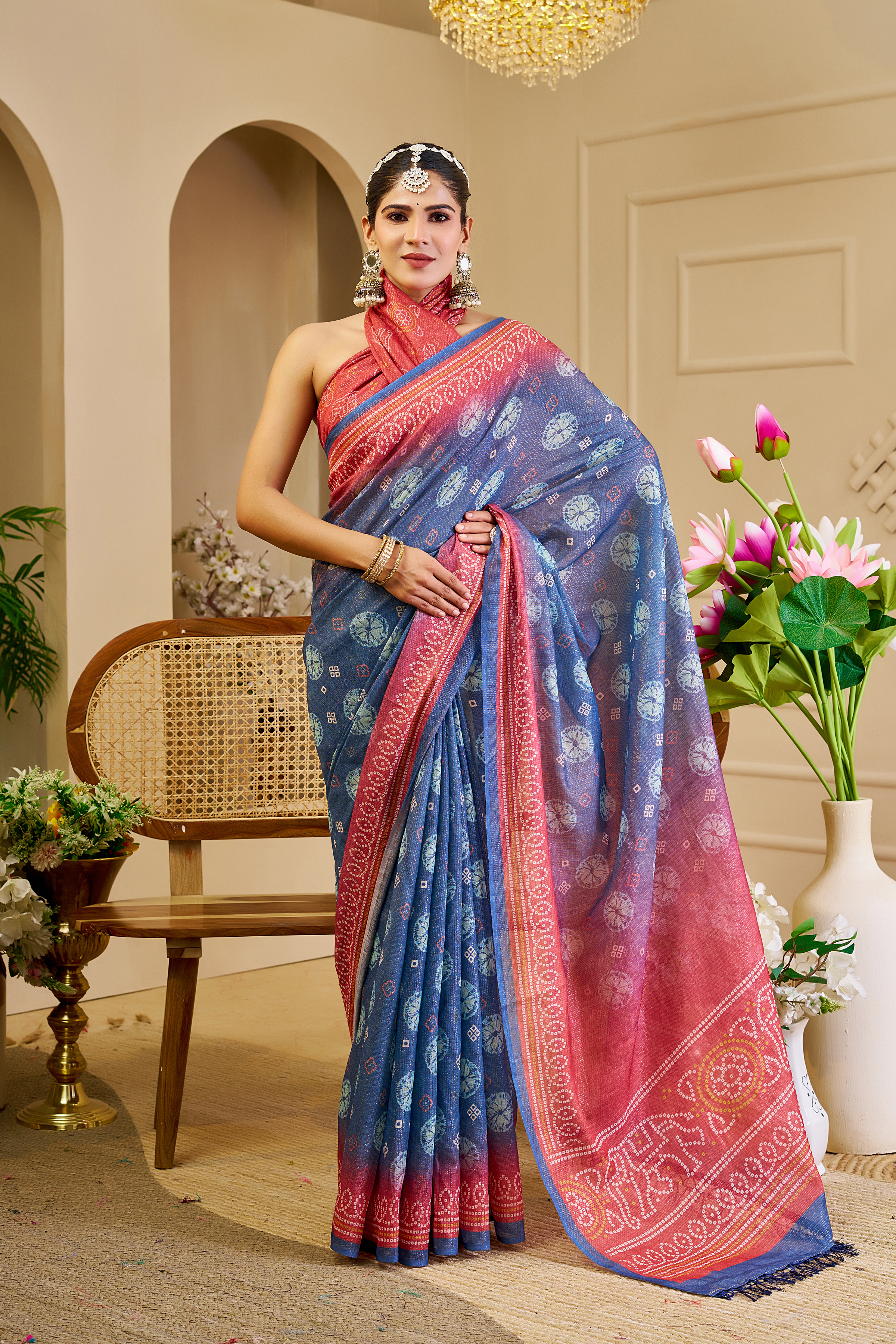
Zari can consist of metallic-coated thread, silver or gold-based material, or a synthetic imitation. The word "zari" alone doesn't identify the metal content. Blue Red Ikat Silk Saree Online with Zari brings together three useful buying questions: what silk type is used, whether the Ikat is woven or printed, and what material makes up the zari.
Border width changes the visual balance of a saree. A broad contrast border creates a structured silhouette and looks effective when front pleats are arranged neatly. A narrow border allows the central Ikat field to dominate. A blouse that repeats one minor colour from the motif usually looks more considered than a blouse that introduces several unrelated colours.
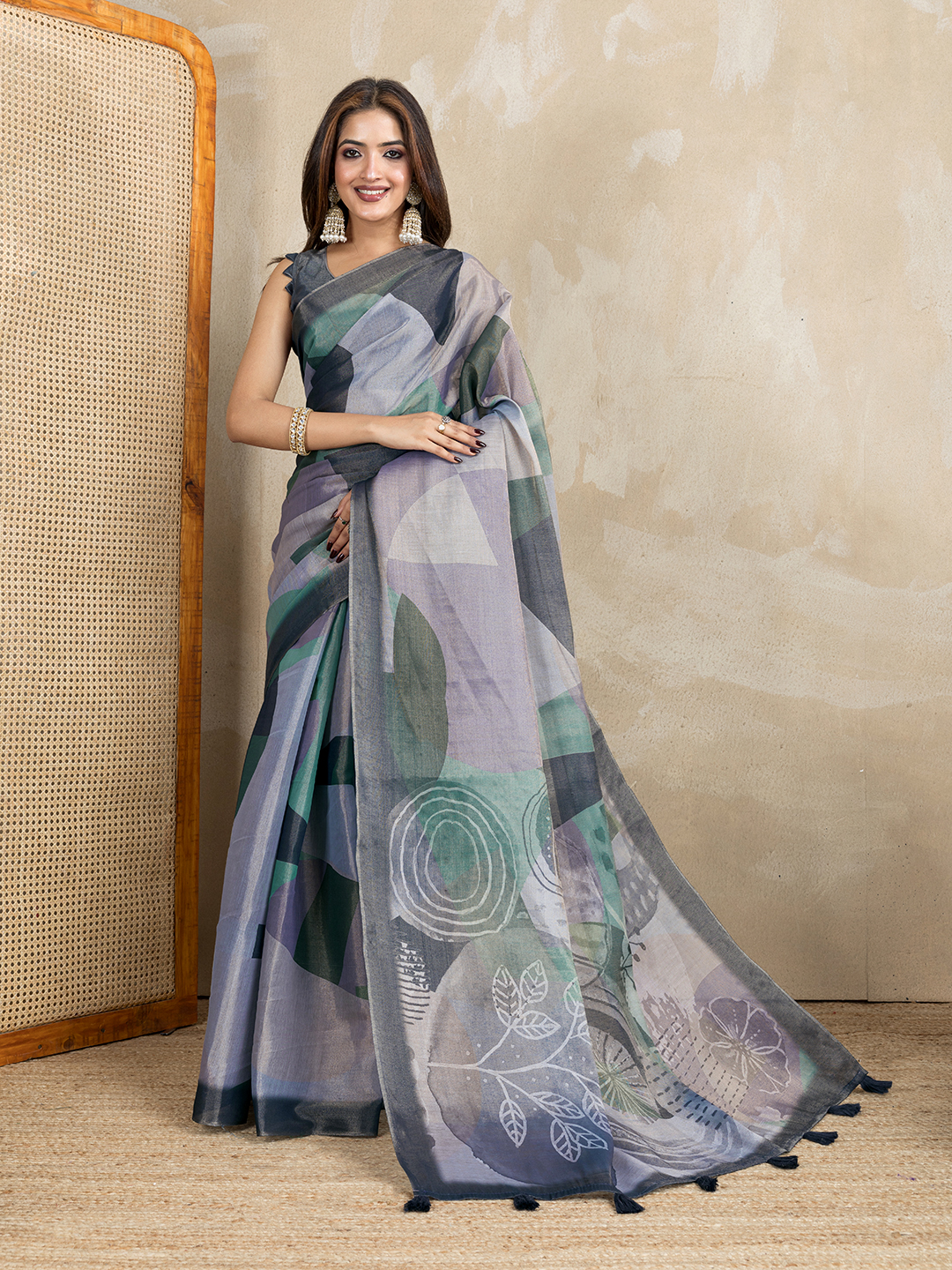
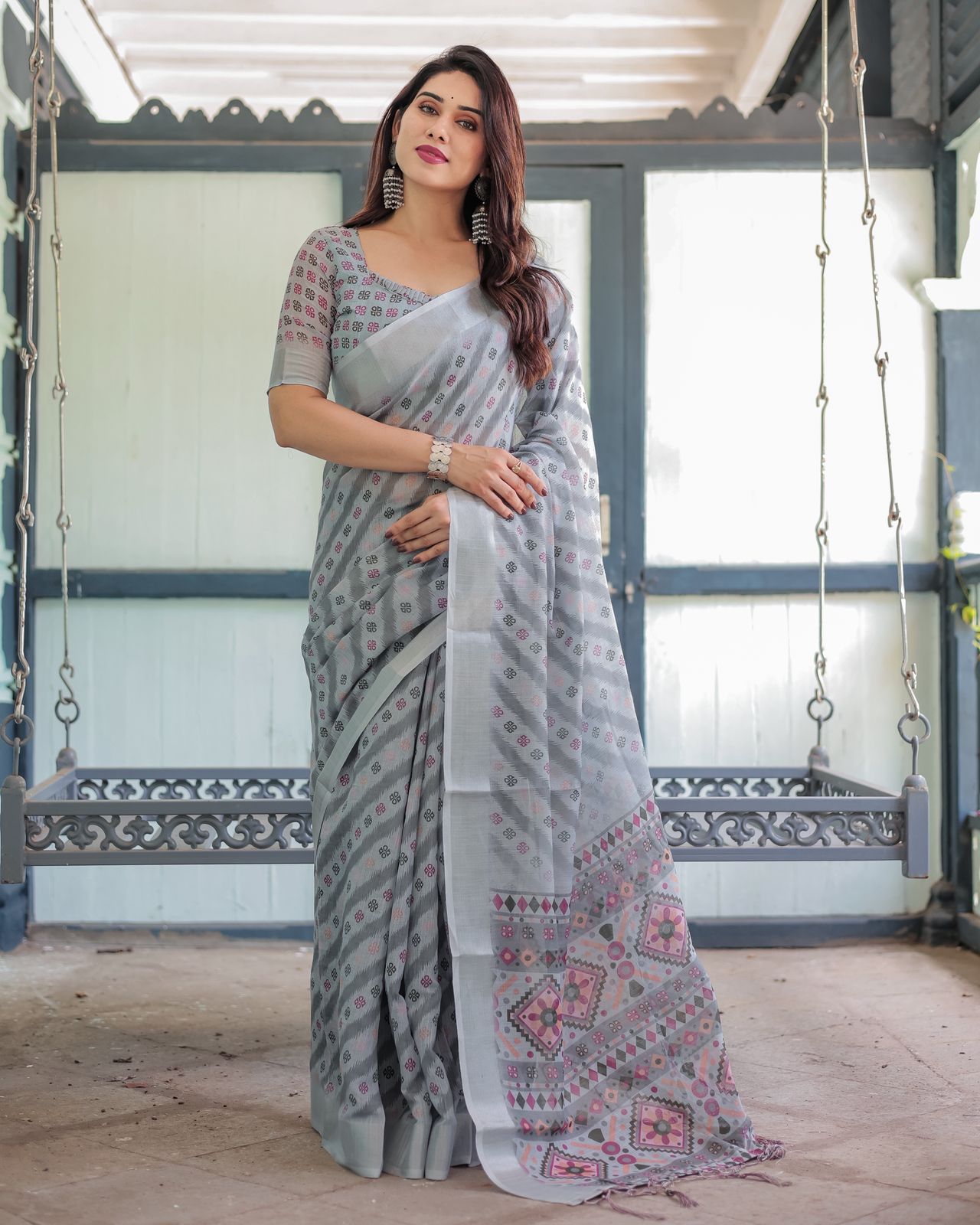
Grey Ikat Print Linen Saree with Elegant Design and Soft Grey Pure Linen Ikat Printed Saree with Blouse show how linen can carry an Ikat-inspired appearance without being silk. Linen normally has a crisper fall and a more matte surface than silk. Linen responds well to careful pressing, while silk generally benefits from lower heat and a protective cloth.
Purple Pink Ikat Print Saree with Decorative Border offers another useful styling example. A decorative border deserves space in the pleats and pallu, so heavy jewellery or a heavily embroidered blouse may obscure the saree's most informative design feature.
Telangana Pattu Cheera and the Distinction Between Silk and Ikat: How Should You Style and Care for It?
A Telangana silk or Ikat saree should be styled according to its fibre, weight, border and occasion rather than by colour alone. A precise pleat arrangement, suitable blouse texture and proportionate jewellery allow the weave or motif to remain visible.
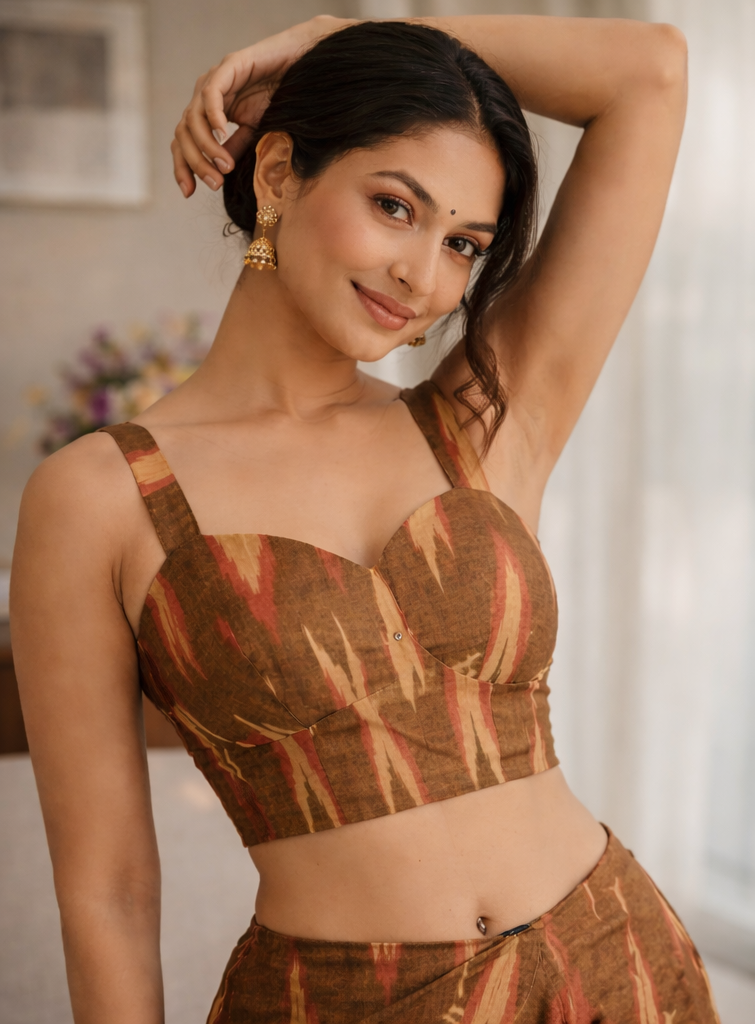
For a Haldi ceremony, a bright Ikat saree with a simple blouse is practical and lets geometric motifs remain prominent. For a wedding, a silk body with a zari border can support a structured blouse, temple jewellery or a restrained gold-toned necklace. A muted linen saree suits a daytime gathering, work event or cultural programme better than a heavily embellished evening reception.
Keep the pallu spread wide when the design contains strong horizontal bands. Use narrower pallu pleats when the border or zari edge is the visual focus. An ivory, charcoal, deep green or muted purple blouse can calm a high-contrast Ikat pattern, while a blouse matching a small accent colour can create cohesion without copying the entire saree.
Store silk sarees in clean cotton or muslin rather than plastic for long periods. Refold a silk saree every few months along different lines to reduce permanent crease stress, and keep zari away from damp walls, perfumes and direct sunlight. Air the saree in shade before folding it again.
Dry-clean silk sarees when the care label recommends it, and don't rub a stain aggressively. For ironing, use low heat, place a clean cotton cloth between the iron and the saree, and work from the reverse where possible. Cotton and linen can tolerate different temperatures, but the care label should take priority because finishes and blends vary.
Telangana Pattu Cheera and the Distinction Between Silk and Ikat: Common Questions
Is every Telangana Pattu Cheera an Ikat saree?
No, every Telangana Pattu Cheera isn't an Ikat saree. Telangana silk sarees can use plain weaves, contrasting borders, other motifs or printed designs, while Ikat is a specific yarn-resist patterning method.
Can a saree be both silk and Ikat?
Yes, a saree can be both silk and Ikat. Silk identifies the fibre, and Ikat identifies the way the pattern is created before or during weaving.
Is an Ikat print the same as handwoven Ikat?
No, an Ikat print isn't automatically handwoven Ikat. Ikat print usually describes a design applied to finished cloth, whereas woven Ikat requires resist-dyed yarns to be arranged on a loom.
What is Pochampally Ikat known for?
Pochampally Ikat is known for yarn-resist weaving and geometric patterns such as diamonds, checks, chevrons and stepped forms. The region's Ikat tradition can use cotton, silk or other fibres, so Pochampally identity should not be confused with silk content.
How can I tell whether an Ikat saree is silk?
Check the fibre label first, then consider the lustre, handle and drape. Visual inspection can't reliably prove silk purity, so a clear fibre specification or professional testing is more dependable than a home burn test.
How should zari silk sarees be stored?
Zari silk sarees should be folded in clean breathable fabric and kept away from dampness, perfume, direct sunlight and rough surfaces. Refolding periodically and using low heat with a pressing cloth can help reduce crease and tarnish damage.
Common Questions About Telangana Pattu Cheera and Silk-Ikat Weaves
Is every Telangana Pattu Cheera an Ikat saree?
No. Telangana Pattu Cheera can refer to a Telangana silk saree without specifying Ikat; Ikat is a separate yarn-resist patterning technique.
Can one saree be both silk and Ikat?
Yes. Silk identifies the fibre, while Ikat identifies how the pattern is produced, so a silk saree can carry a woven Ikat design.
Is Ikat print the same as handwoven Ikat?
No. Ikat print usually means a design printed on finished cloth, while woven Ikat uses resist-dyed yarns arranged on a loom.
What is Pochampally Ikat known for?
Pochampally Ikat is known for yarn-resist weaving and geometric motifs such as diamonds, checks, chevrons and stepped forms. Pochampally Ikat may use cotton, silk or other fibres.
How can I check whether an Ikat saree is silk?
Read the fibre label first and then compare lustre, handle and drape. A professional fibre test is more reliable than a home burn test, which can damage the saree and release harmful fumes.
How should a zari silk saree be stored?
Store a zari silk saree in clean breathable fabric away from dampness, perfume, direct sunlight and rough surfaces. Refold it periodically and use low heat with a pressing cloth when ironing.