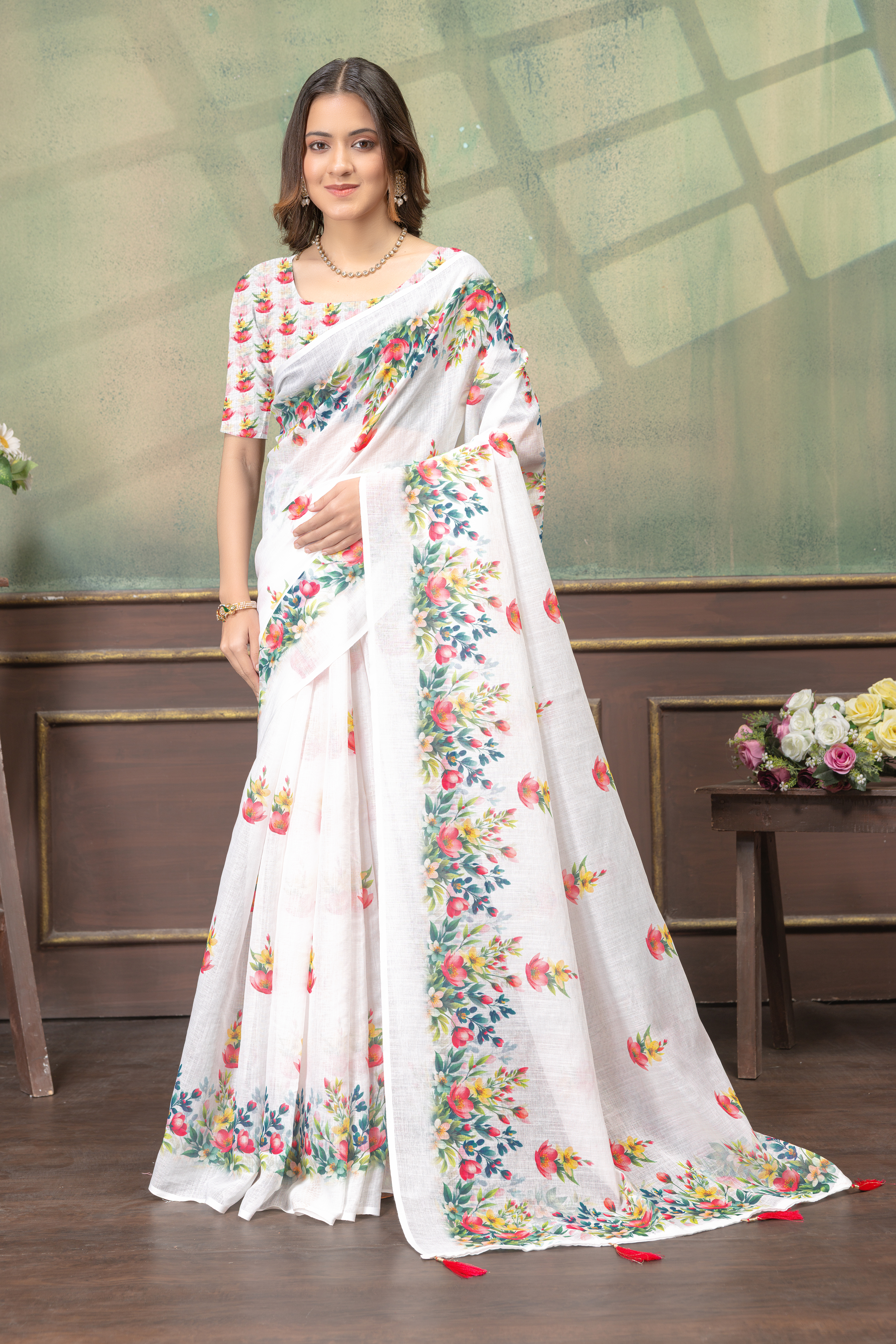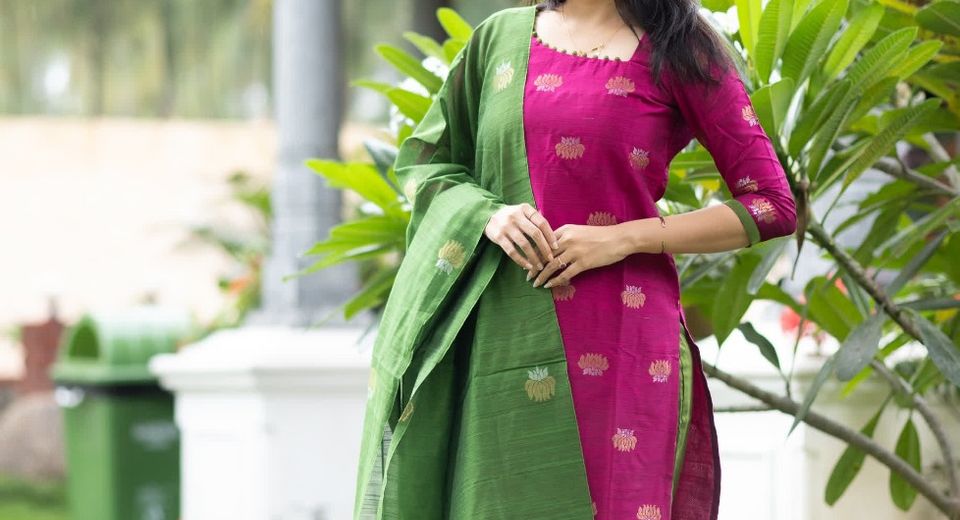
Why Kalamkari Kurtis Never Look Like Ordinary Printed Kurtis becomes easier to respond when you look beyond the first layer of colour. Kalamkari combines narrative motifs, controlled linework, layered pigment and a visible vocabulary shaped by temple art and textile traditions. A ordinary printed kurti may repeat a surface pattern, while a Kalamkari kurti often makes the fabric feel like an illustrated panel. The difference lies in how the motif is drawn, arranged, coloured and adapted to the garment.
Why Kalamkari Kurtis Never Look Like Ordinary Printed Kurtis in the First Place
Kalamkari differs from an ordinary print because its design language is built around hand-drawn or hand-rendered imagery, narrative composition and layered colour rather than a purely repetitive surface pattern. The word Kalamkari is associated with kalam, or pen, and kari, or work, which highlights the importance of line in the tradition.
Traditional Kalamkari developed in parts of Andhra Pradesh and Telangana, with two important streams commonly discussed: Srikalahasti Kalamkari, known for freehand pen drawing and narrative imagery, and Machilipatnam Kalamkari, known for block printing combined with painted details. Contemporary garments may use screen printing, digital printing or adapted production methods, but strong Kalamkari-inspired designs often retain recognisable elements such as confident outlines, plant forms, birds, animals and ornamental borders.
An ordinary printed kurti usually depends on a repeat unit. The same flower, vine or geometric shape is reproduced at regular intervals across the cloth. Kalamkari can also include repeats, but the repeat is often interrupted by borders, medallions, figures or directional movement. The eye therefore travels across the garment alternatively of stopping at a predictable grid.
The distinction doesn't mean that every Kalamkari garment is hand-painted or naturally dyed. A garment should be described according to its stated production method, fabric and care instructions. The visual language of Kalamkari can be adapted for modern production while still drawing from the traditional design vocabulary.
Why Kalamkari Kurtis Never Look Like Ordinary Printed Kurtis When Motifs Tell a Story
Kalamkari motifs feel expressive because they combine identifiable figures, natural forms and symbolic details into a visual story. A peacock may suggest beauty and auspiciousness, a flowering vine may represent abundance, and a temple-inspired border may frame the garment like an architectural panel.
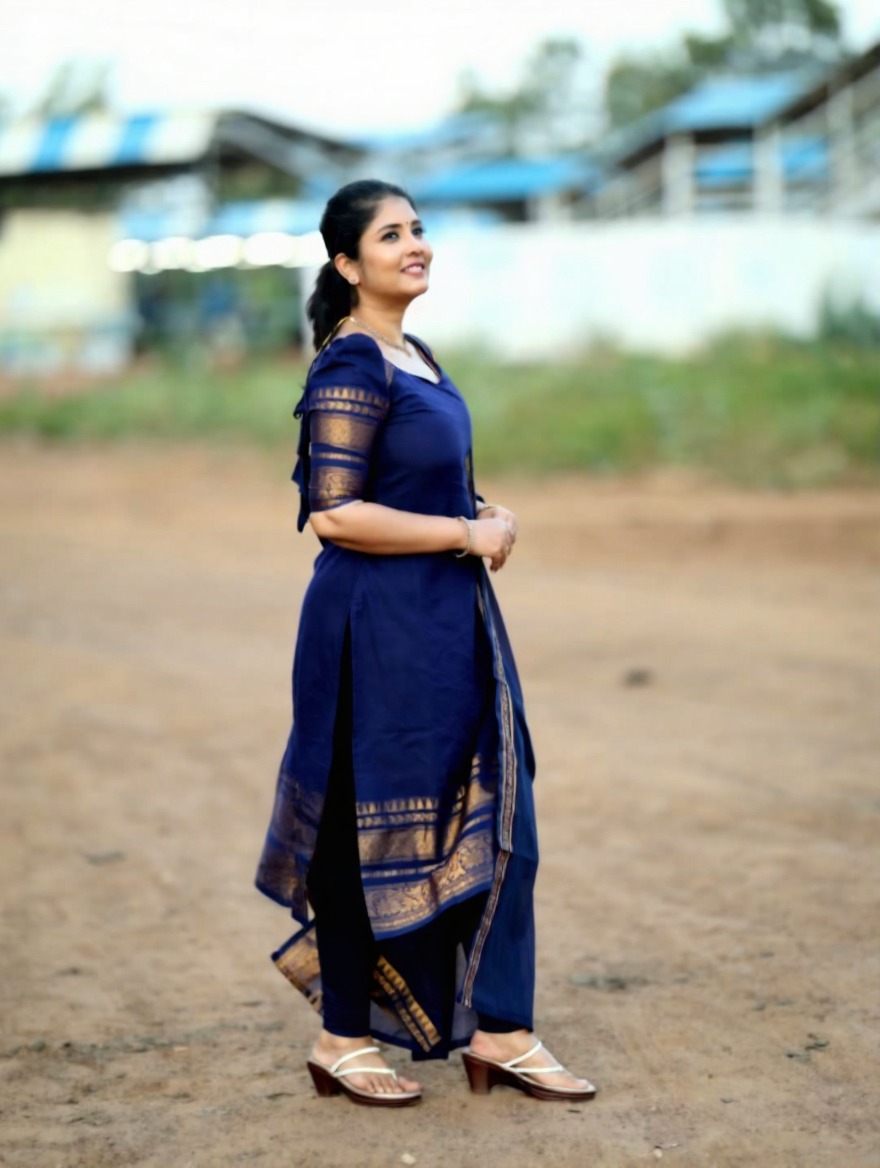
Common Kalamkari imagery includes lotus flowers, creepers, parrots, peacocks, deer, elephants, fish, trees and scenes linked to the Ramayana or Mahabharata. Not every contemporary Kalamkari kurti contains a religious narrative, and not every floral design qualifies as a traditional Kalamkari composition. The useful distinction is the way motifs are developed. Kalamkari linework often gives leaves, feathers and petals a drawn contour, allowing small variations in direction and scale.
Ordinary printed kurtis frequently use a single oversized floral motif or a compact all-over pattern to create an immediate fashion effect. Kalamkari uses visual hierarchy. A large central motif may be supported by smaller fillers, a border may establish the hemline, and a contrasting yoke or dupatta may extend the story. These decisions create the impression of an illustrated textile rather than a random print placed on a garment.
The story doesn't always need to be read literally. A wearer may not identify every mythological character or botanical symbol, yet the composition can still feel distinctive because the elements have been arranged with rhythm. That rhythm explains why two Kalamkari Kurtis with similar red, mustard or indigo palettes can look completely different.
Why Kalamkari Kurtis Never Look Like Ordinary Printed Kurtis in Colour and Line
Kalamkari colours create visual depth through contrast, outlining and the appearance of layered pigment. Traditional Kalamkari palettes commonly bring together earthy red, black, mustard, indigo, rust, green and cream, although contemporary garments may use a much wider range.
Natural-dye Kalamkari historically involved dyes such as indigo for blue, madder or related sources for red, and iron-based solutions for black. The precise process varies by artisan, region and product, so a current garment should not automatically be described as naturally dyed. Even when a contemporary Kalamkari print uses synthetic colour, the visual reference often remains visible in the combination of a strong outline, warm ground colour and carefully placed accents.
Colour blocking also contributes to the difference. A Kalamkari panel may place a dark bird against a muted background, then repeat a small red or mustard detail in the border. The garment gains depth because the colours have distinct jobs within the composition. A routine printed kurti may use several colours attractively, but the colours often function mainly as decoration rather than as a structured visual system.
Colour density deserves attention when buying online. Deep, complex-looking colour doesn't prove that a fabric contains natural dyes, and slight irregularity doesn't automatically prove hand painting. Product descriptions should be checked for fabric composition, printing method and care instructions instead of relying on colour alone.
Why Kalamkari Kurtis Never Look Like Ordinary Printed Kurtis When Fabric Changes the Effect
The fabric matters because the same Kalamkari artwork can look crisp, soft, formal or casual depending on the ground material and the way the cloth holds colour. Cotton, modal, rayon, silk blends and other bases produce different drape, surface texture and opacity.
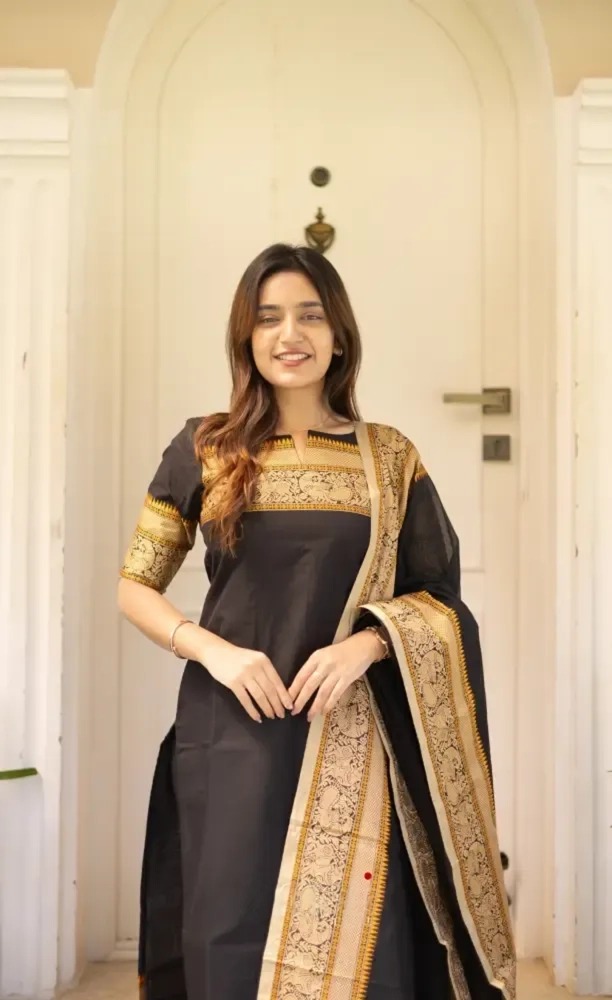
Cotton generally gives Kalamkari-inspired designs a grounded, breathable character that suits daytime wear and warm weather. A firmer cotton can support clear borders and structured straight kurtis, while a softer cotton may fall closer to the body. Rayon can create a fluid drape and stronger colour saturation, but rayon garments may require more careful washing and drying. Silk or silk-blend bases can make a narrative print feel more festive, especially when paired with zari or a woven dupatta.
The contrast becomes useful when comparing regional textile aesthetics. Blue Kanchi Cotton Jacquard Kurti with Elegant Dupatta may rely on woven texture and jacquard structure rather than a painted narrative. Purple Kanchi Cotton Kurti Set with Zari Dupatta introduces festive shine through zari, while Kalamkari introduces character through line, motif and composition. Both can look richly detailed, but their richness comes from different textile techniques.
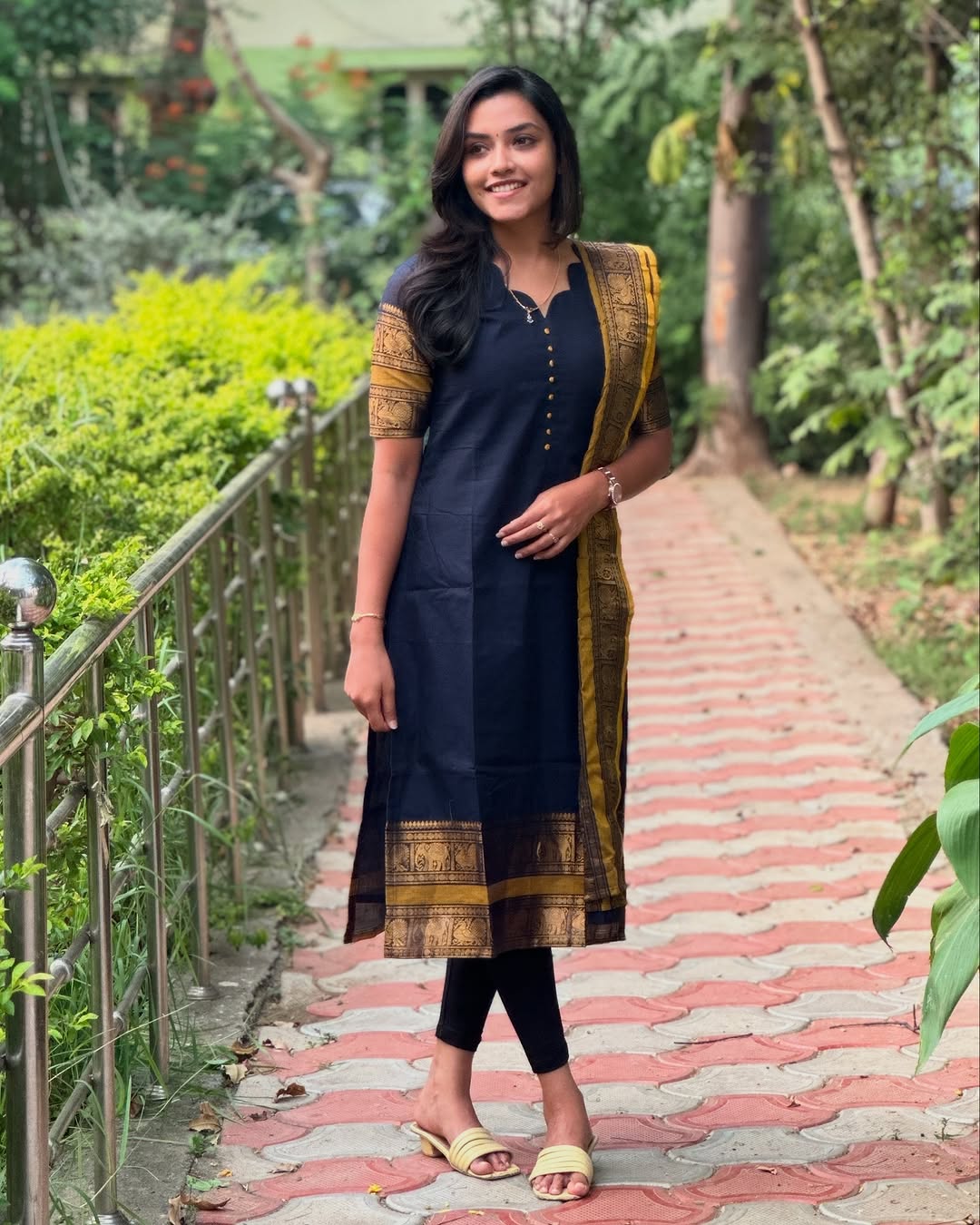
Other examples include Navy Kanchi Cotton Kurti Set with Woven Dupatta and Royal Navy Blue Kanchi Cotton Kurta Set with Elegant Woven Dupatta. Woven dupattas create interest through construction, selvedge, texture or pattern integration; Kalamkari creates interest through illustrated imagery. Recognising that distinction helps a shopper choose according to the kind of detail they actually want.
Black Kanchi Cotton Kurti Dupatta Set for Women, Black Kanchi Cotton Jacquard Kurti with Woven Dupatta Set and Black Jacquard Woven Kanchi Cotton Kurti Set also demonstrate how dark colour and woven surfaces can create a polished ethnic look without using narrative print. A black base may make Kalamkari motifs appear especially vivid, but colour alone doesn't determine whether a garment belongs to the Kalamkari tradition.
How to Recognise Why Kalamkari Kurtis Never Look Like Ordinary Printed Kurtis
A considered Kalamkari design usually shows a clear motif family, deliberate borders, visible line hierarchy and balanced spacing across the garment. A random floral print often places similar flowers at equal intervals without a strong relationship between the neckline, body, sleeve and hem.
Check the linework
Look for outlines that define petals, feathers, leaves or figures instead of flat shapes with no internal detail. Kalamkari-inspired linework may be fine or bold, but it normally gives the motif a drawn presence. Slight variation can be attractive; blurred edges, accidental gaps and muddy registration are quality concerns rather than signs of authenticity.
Check the placement
Inspect the neckline, sleeve edge, hem and dupatta separately. A well-planned Kalamkari salwar suit may use a border at the hem, a smaller repeat on the sleeve and a larger focal design on the kurta body. A generic floral print often ignores garment panels, causing a major flower to disappear under a seam or fall awkwardly at the bust.
Check the motif vocabulary
Peacocks, parrots, lotus blooms, creepers, trees, elephants and temple-style borders are useful clues, but motif presence alone isn't proof of traditional origin. The arrangement, drawing quality and stated production method matter too. Terms such as Kalamkari print can describe an aesthetic reference rather than a fully hand-painted textile.
Check the reverse side and surface
The reverse side can offer useful information about colour penetration, but it can't authenticate a textile on its own. A printed fabric may show colour mainly on the face, while some dyeing or painting processes allow more colour to pass through. A smooth, perfectly uniform surface may suggest machine printing, but contemporary production methods can still reproduce a detailed Kalamkari-inspired design attractively.
Why Kalamkari Kurtis Never Look Like Ordinary Printed Kurtis in a Salwar Suit
Kalamkari fits naturally into salwar suits because the kurta, pants and dupatta provide separate surfaces for a narrative design to develop. The longer kurta body can carry a central panel, the sleeves can repeat a smaller motif, and the dupatta can provide a border that completes the composition.
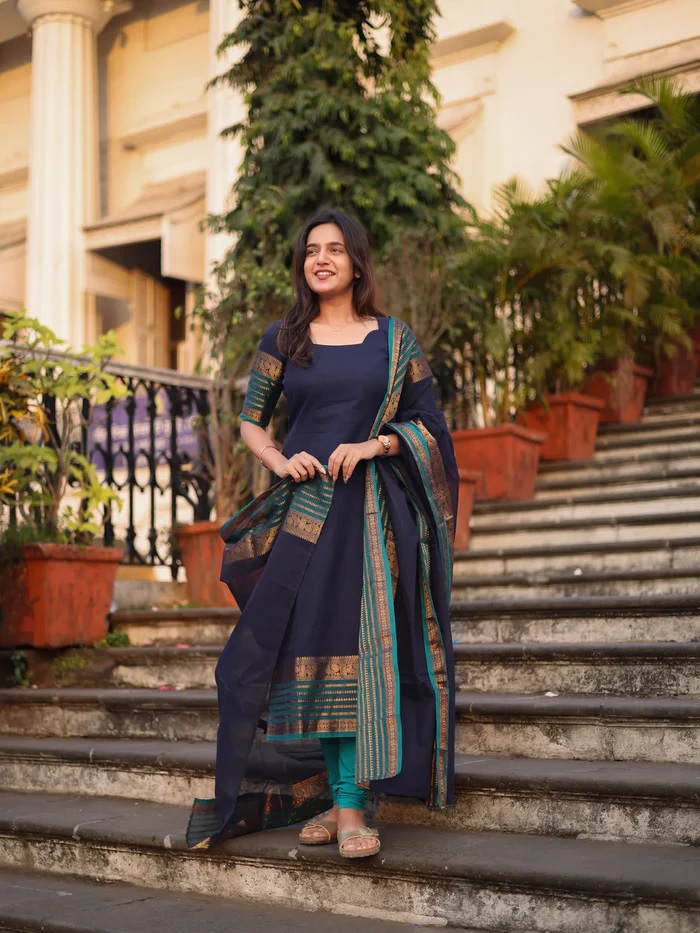
Kalamkari Print Salwar Suits (Copy) points directly to the use of storytelling print within a three-piece silhouette. A salwar suit also gives the wearer more control over proportion than a single printed kurti. A busy Kalamkari kurta can be balanced with solid trousers, while a quieter kurta can work with a patterned dupatta.
Regional comparison makes the distinction even clearer. Maharashtra Paithani Inspired Salwar Suits typically draw visual interest from Paithani-associated colour contrasts and woven-style motifs. Gujarat Bandhej Salwar Suits refer to the dotted, tie-dye-inspired language of Bandhej. Odisha Sambalpuri Salwar Suits often evoke the distinctive geometric, figurative and nature-linked vocabulary associated with Sambalpuri textiles. These traditions are not interchangeable with Kalamkari, even when all four appear in the broad category of Indian ethnic wear.
A salwar suit can communicate craft in different ways. Kalamkari communicates through drawn narrative and botanical imagery; Paithani-inspired design communicates through luxurious colour contrasts and woven-style motifs; Bandhej communicates through dotted resist-dye effects; Sambalpuri communicates through regional geometric and figurative patterning. Punjab Patiala Salwar Suits add another useful contrast because their identity is strongly connected to the Patiala salwar silhouette and Punjabi styling rather than to Kalamkari imagery.
How to Style Why Kalamkari Kurtis Never Look Like Ordinary Printed Kurtis
Kalamkari styling works best when the accessories support the print instead of competing with every motif. Solid bottoms, restrained jewellery and one repeated accent colour usually create a more coherent outfit.
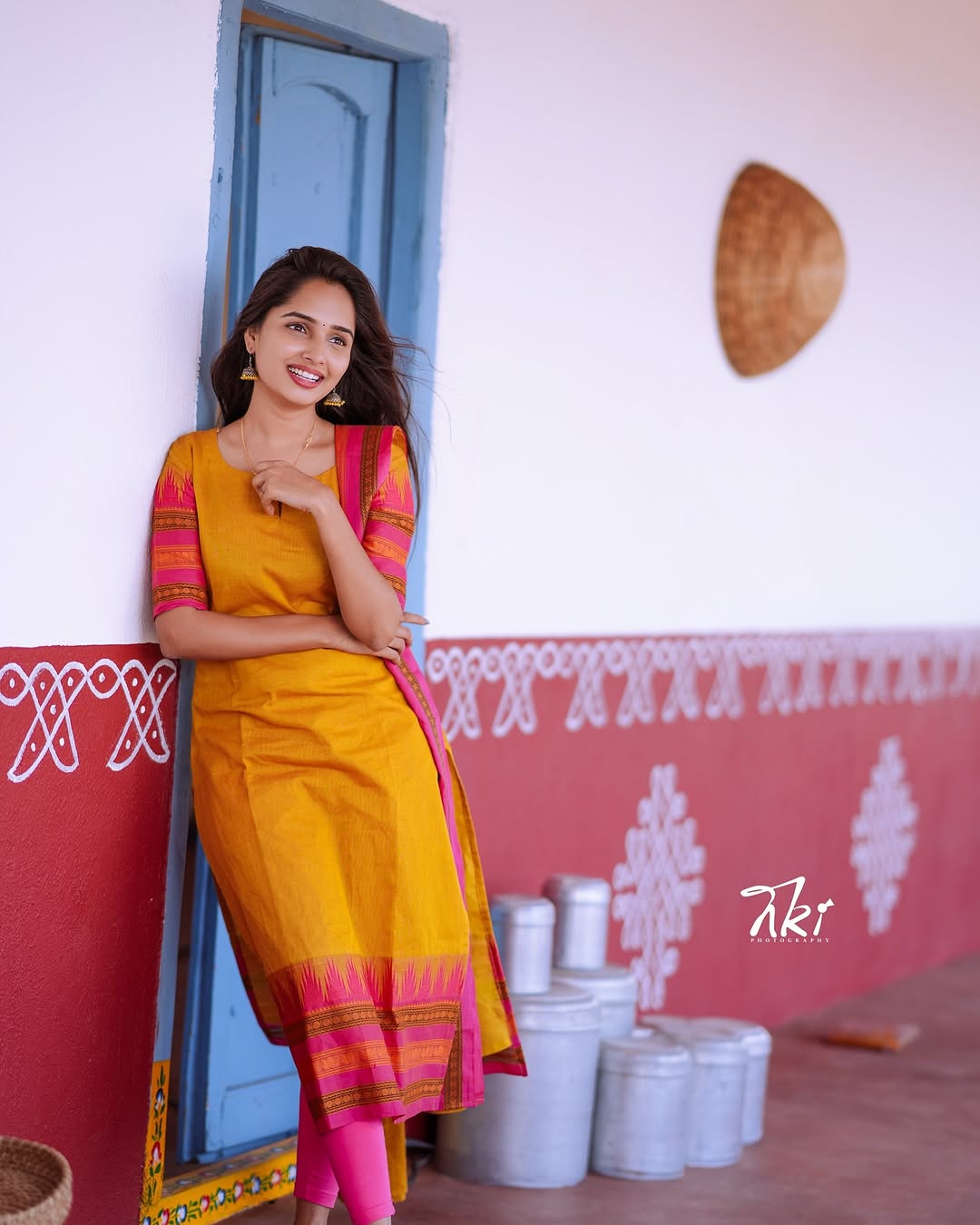
For a daytime look, pair a busy Kalamkari kurta with straight cotton trousers in cream, black, indigo or one of the quieter shades in the print. Choose flat kolhapuris, juttis or simple sandals, and keep the dupatta border visible rather than bunching the fabric around the neck. A small oxidised silver earring can complement earthy motifs without adding another competing pattern.
For an office-friendly outfit, select a Kalamkari design with controlled contrast and a straight silhouette. A solid cigarette pant, low-contrast dupatta and structured tote can make the print feel polished. Avoid combining a large floral Kalamkari kurta with a heavily embellished bottom, a large statement necklace and a contrasting printed bag, because three strong focal points can make the composition look crowded.
For a family gathering, zari, a silk-blend dupatta or antique-gold jewellery can raise the formality of a Kalamkari salwar suit. Keep the metallic element concentrated in one place. A zari border or earrings may be enough when the Kalamkari artwork already occupies the entire kurta body.
Fit also changes how the artwork reads. A straight kurta preserves the vertical flow of a border, an A-line kurta gives larger motifs room to spread, and an Anarkali silhouette can make a lower border particularly prominent. Sleeve length, neckline depth and side slits should be considered before selecting a design with large motifs near the bust or upper arm.
How to Care for Kalamkari Kurtis Without Dulling Their Character
Kalamkari garments should be cared for according to their fibre and dye instructions, but gentle washing, shade drying and limited friction are safe general practices. Care requirements differ between cotton, rayon, silk blends and garments made with natural or synthetic dyes.
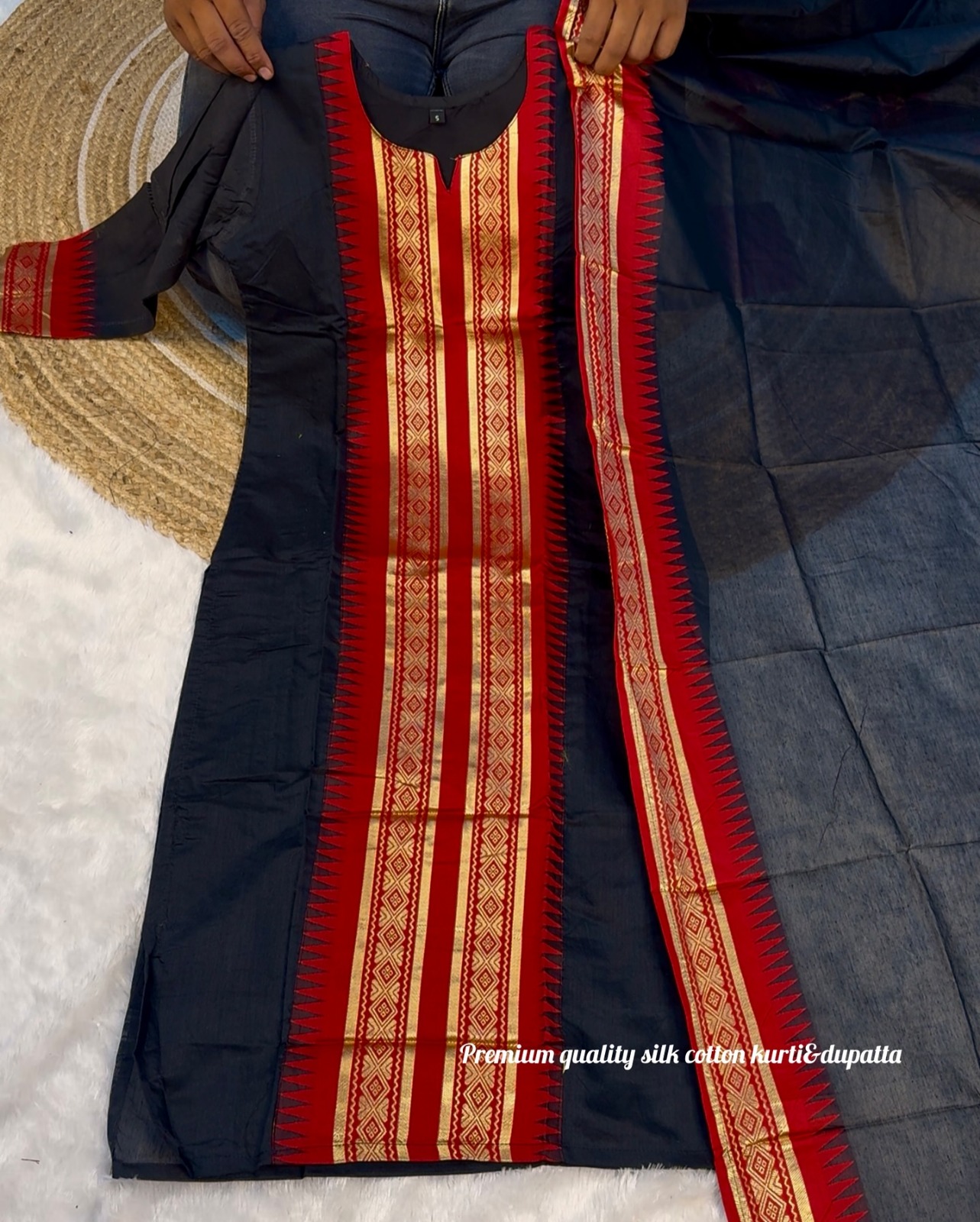
Read the product label before the first wash. If hand washing is permitted, use cool or lukewarm water, a mild detergent and a short soak of about five to ten minutes. Avoid vigorous rubbing on printed areas, because friction can weaken surface colour and damage delicate outlines.
Wash dark and light garments separately, especially during the first few washes. Do not wring a wet kurta aggressively. Press out excess water with a clean towel, reshape the garment and dry it inside out in indirect sunlight. Strong midday sun can fade some dyes and pigments over time.
Iron Kalamkari fabric on the reverse side or place a thin cotton cloth between the iron and the print. Use a low or medium setting appropriate to the fibre. Store the garment clean and fully dry, folded away from direct light. Rayon and silk-blend garments may require dry cleaning or a more specific method, so a general cotton-washing routine should not be applied automatically.
The visual individuality of Kalamkari comes from the relationship between line, motif, colour, fabric and garment construction. That combination explains why Kalamkari Kurtis never look like ordinary printed kurtis: the design isn't merely placed on the cloth but organised to give the cloth a sense of movement, meaning and regional identity.
Common Questions About Kalamkari Kurtis and Salwar Suits
Are Kalamkari Kurtis always hand-painted?
No, Kalamkari Kurtis are not always hand-painted. Traditional Srikalahasti Kalamkari is associated with freehand pen work, while contemporary garments may use block printing, screen printing or digital printing inspired by Kalamkari motifs. Check the product description for the stated technique instead of assuming that every Kalamkari print is handmade.
What is the difference between Kalamkari and a regular floral print?
Kalamkari usually has a stronger design vocabulary based on outlined motifs, narrative imagery, botanical forms and planned borders. A regular floral print often depends on a repeated flower or geometric unit without the same level of visual storytelling or garment-specific placement.
Which fabrics are commonly used for Kalamkari Kurtis?
Cotton is commonly used for breathable, structured Kalamkari Kurtis, while rayon can provide a softer and more fluid drape. Silk blends and other fabrics may be used for dressier versions. The fabric composition affects colour appearance, comfort, fall and washing requirements.
How should a Kalamkari salwar suit be styled?
A Kalamkari salwar suit is usually easiest to style with solid trousers, a restrained dupatta arrangement and accessories that repeat one colour from the print. Juttis, kolhapuris, oxidised silver and antique-gold jewellery can work well, depending on the palette and level of formality.
How do you wash a Kalamkari kurti?
Follow the garment label first, then prefer cool or lukewarm water, mild detergent and minimal soaking when hand washing is allowed. Wash dark colours separately, avoid harsh rubbing and dry the garment inside out in shade. Rayon, silk blends and naturally dyed garments may need more specific care.
How can shoppers identify a well-designed Kalamkari print online?
Look for clear motif outlines, balanced placement across the kurta and dupatta, coordinated borders and a stated fabric and printing method. Product photographs showing the neckline, sleeve, hem and reverse side are more useful than a single close-up image. Colour depth alone does not prove that a design is traditional or hand-painted.